
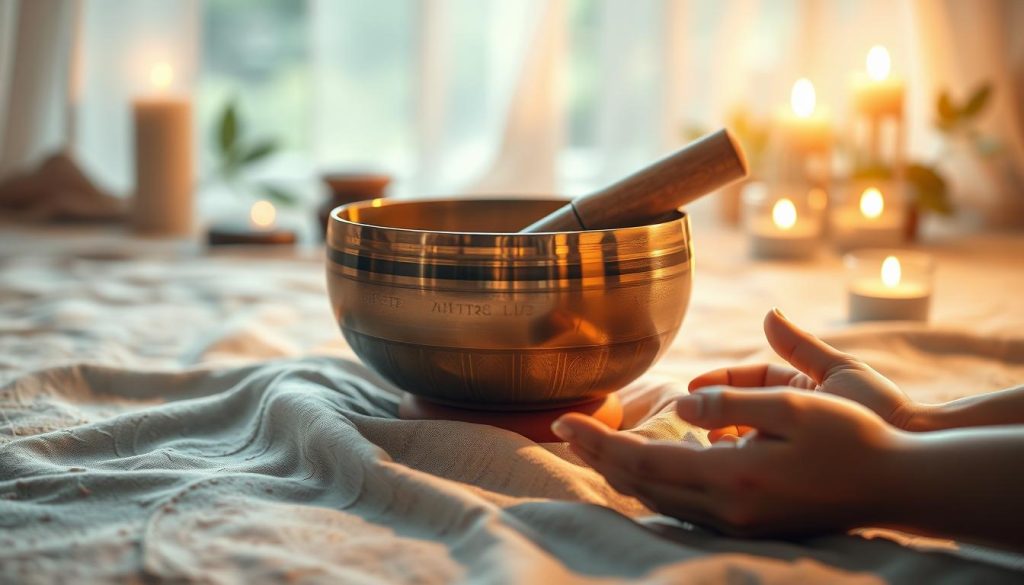
Discover a simple introduction to incorporating sound therapy into your relaxation routine.
This guide explains how ancient sounds can help calm the mind.
Regular short sessions can promote a better quality of life. They may also help reduce stress and refocus attention.
Meditation can become deeper with the help of sound cues. Vibrations reinforce concentration and grounding during each session.
This practical guide describes the main well-being benefits and offers advice on choosing and handling the instrument.
To learn how to use these tools safely, follow this complete guide.
Understanding Tibetan singing bowls and their origins
The origins of this instrument date back to ancient practices, long before its ritual use.
An ancient history connected with the sacred
Its history is said to date back to around 5,000 BC, when these vessels were initially used as tableware.
Over time, their shape and sound earned them a place in the sacred practices of Himalayan temples.
“Each bowl carries the memory of craftsmanship passed down from one generation to the next.”
Evolution into a therapeutic tool
The traditional composition is based on a so-called seven-metal alloy, including gold and silver.
This metallic structure directly influences the harmonics produced when the bowl is played.
- Local craftsmanship provides rich resonance.
- Ritual use preserves purification techniques.
- Its use has evolved toward meditation and modern sound practices.
Understanding the origins of this alloy helps us appreciate the instrument’s historical and spiritual value and its current role in well-being.
Sound and vibration mechanisms
The waves emitted by a vibrating bowl travel through the air and reach the body.
A singing bowl produces mechanical vibrations that spread throughout the room. These waves may sometimes be felt as tingling or gentle warmth on the skin.
When you strike the instrument, the pressure applied to its walls creates a complex wave. This wave contains numerous harmonics that provide a rich acoustic experience.
Each Tibetan singing bowl sounds different depending on its size, thickness, and alloy. These differences alter the frequency and duration of its resonance.
The vibrations emitted by singing bowls act as a steady signal for the nervous system. The effect is often a rapid calming of the breathing rate.
Rubbing with constant pressure sustains continuous resonance and creates an immersive envelope of sound. Placing the instrument near a tense area of the body intensifies the sensation.
- Tip: adjust the force and position to control the quality of the vibrations.
- The room and surrounding objects influence the final sound experience.
Tibetan singing bowls: benefits, uses, and limitations to know
Sound therapy often provides deep relaxation, even during a short session.
Session length varies by setting: 20 to 40 minutes at a spa and 45 to 75 minutes for a private consultation. These durations are suitable for a gentle sound massage or guided relaxation.
In some cases, singing bowls may help relieve minor tension. This practice remains complementary and is not a substitute for medical care. Always disclose your medical history before a session to help ensure a safe experience.
Everyone responds differently. Allow time to process the experience after treatment so you can fully benefit from its effects. Regular practice often supports better day-to-day stress management.
- Spa session: 20 to 40 min.
- Private consultation: 45 to 75 min.
- Versatility: quick relaxation or structured support, depending on your needs.
Tip: begin with short sessions and increase their length if you find the experience suitable.
Effects on the nervous system and relaxation
A targeted frequency may trigger a relaxation response in the nervous system.
The 110 Hz vibrations emitted by a Tibetan singing bowl are said to stimulate the parasympathetic nervous system. This signal may promote deep relaxation and slow the breathing rate.
Supporting sleep and recovery
After 3 to 6 regular sessions, some people report a noticeable improvement in their sleep. Repetition may also support physical and mental recovery.
- Tibetan singing bowls often help reduce muscular tension that has accumulated in the body under stress.
- The resulting relaxation acts as a safety signal for the brain, making it easier to enter meditation.
- Regular practice stabilizes the effects and strengthens the resilience of the nervous system.
Advice: begin with short sessions and observe the quality of your sleep before increasing their duration.
Health precautions and contraindications
Certain medical conditions require particular care before using a sound-producing instrument during a session.
Medical devices and implants: people with pacemakers, defibrillators, or other implants should consult their doctor before exposure to vibrations. Vibrational fields, even weak ones, may interact with certain devices.
Medical devices and implants
If you have an implant, seek advice from a healthcare professional and inform the practitioner leading the session.
Hearing sensitivity and overexposure
It is essential to avoid excessively loud sounds: some bowls exceed 80 dB, a level that may damage hearing. Keep the instrument away from the ears and reduce the intensity if you experience discomfort.
- If you develop a headache or nausea, stop the session immediately.
- Metal alloys may cause skin reactions; avoid direct contact if you have sensitive skin.
- If in doubt, drink some water and take a break to allow your nervous system to settle.
- Understanding contraindications associated with heart conditions is essential before handling the instrument.
Practical advice: adapt the length and intensity of each session to the individual. Responsible practice minimizes risks and optimizes the effects on the body.
Preparing your space for a peaceful session
Creating a dedicated space turns each session into a ritual that encourages relaxation.
Place your Tibetan singing bowl on a stable cushion to preserve its resonance without muffling it. Stability is crucial: a poorly supported instrument produces a less clear and shorter-lasting sound.
For the bowl-on-palm technique, keep your hand open and relaxed. Allow the vibrations to move freely through your body and adjust the pressure according to how it feels.
Choose a comfortable posture and allow enough time to settle in. A calm, orderly environment promotes concentration and reinforces relaxation.
Protect your bowls with a suitable cushion: this extends the instrument’s lifespan and improves sound quality. Before beginning, check its position and take a brief moment to observe.
Tibetan singing-bowl massage: precautions
Techniques for making your bowl sing
The gestures you use determine the purity and duration of the resonance.
Choosing the right position improves sound quality. Place the bowl on a stable cushion or hold it in your open hand. Prepare your breathing so that it synchronizes with each strike and circular movement.
The striking method for clear notes
Use a suitable mallet and gently strike the rim. Let the bowl vibrate freely after impact. Proceed gradually to avoid a harsh or aggressive sound.
The rubbing method for continuous sounds
Move slowly around the rim in a circle. Maintain constant, even pressure. Moving too quickly alters the harmonics; slow down to stabilize the vibrations.
- Synchronize your breath with the duration of the resonance.
- Learn the bowl-on-palm technique without closing your hand, which would muffle the sound.
- Vary the methods to explore different sound textures.
Tip: practice for a few minutes each day to refine the movement and feel its effect in your body.
Choosing the right instrument for your needs
Your choice of instrument influences the effectiveness of the practice.
Size plays a central role. Small bowls produce high-pitched sounds. They are suitable for promoting mental clarity and accompanying short sessions.
Larger instruments offer lower resonance. They encourage deep grounding during relaxation exercises.
Choose a seven-metal alloy whenever possible. This composition provides harmonic richness conducive to well-being.
- Check the quality of the metals to avoid counterfeit products.
- Test how it feels to you: every bowl has a unique signature.
- Consider how easy it is to handle, especially if you are a beginner.
| Criterion | Small instrument | Large instrument |
|---|---|---|
| Frequency | High pitch, clarity | Low pitch, depth |
| Use | Short meditation, concentration | Long relaxation, grounding |
| Handling | Easy for beginners | May require practice |
To make an informed purchase, consult a guide to choosing a Tibetan singing bowl. Investing in quality will give you a durable instrument for your personal practice.
Incorporating singing bowls into a meditation routine
Beginning and ending meditation with a sound cue helps the mind settle quickly.
Use a Tibetan singing bowl to mark the beginning and end of each session. This simple cue structures your time and creates a dedicated space for practice.
The sound acts as an anchor for the body and breath. The resonance often slows the heart rate and facilitates relaxation.
- Sound the bowl gently to focus your attention before meditation.
- Sound the bowl briefly to mark the end of the session and reconnect with your surroundings.
- Practice regularly: 5 to 20 minutes is enough for a beginner.
Tibetan singing bowls can help deepen the practice. Over time, each session becomes richer and more soothing.
The role of accessories in sound quality
Accessories profoundly alter the tone and sustain of the sound produced by your instrument.
Your choice of mallet changes the way a bowl sings. Felt softens the impact on the metal and creates a rounded resonance.
A wooden striker produces a more crystalline sound. It is well suited to playing small bowls precisely.
Practices and recommendations
- Size: the accessory should be proportionate to the size of the bowl.
- Cushion: placing the instrument on a cushion allows it to vibrate freely.
- Hand: keep your hand open when holding the bowl so you do not muffle the sound.
- Combine a wooden striker with a felt mallet to vary the timbre.
- Choose quality tools to protect the instrument’s surface and extend its lifespan.
| Accessory | Sound effect | Recommended use |
|---|---|---|
| Felt mallet | Soft sound, rich in harmonics | Medium to large bowls, relaxation |
| Wooden striker | Clear sound, crisp attack | Playing small bowls precisely |
| Cushion | Extended resonance | Stable support, storage |
Practicing sound massage safely
A safe sound massage begins with clear communication between the practitioner and the person receiving the treatment.
Before the session, review the person’s medical history and obtain their consent. Adjust the duration if any vulnerabilities are reported.
Use a gentle method: move the bowl around the body without pressing on painful areas. Excessive pressure diminishes both resonance and comfort.
The practitioner’s hand guides the movement. It must remain steady and precise to distribute the vibrations harmoniously.
If the bowl does not resonate, do not persist. Never force the movement; change the angle or accessory to maintain safety.
Training is essential. A qualified practitioner understands the effects of Tibetan singing bowls and adapts each massage to promote relaxation.
Respect and safety: design every session around the consent and limits of the person receiving the treatment.
| Key consideration | Recommended action | Reason |
|---|---|---|
| Consent | Questionnaire and verbal discussion | Respect limits and account for risks |
| Method | Gentle circular movement | Even distribution of vibrations |
| Safety | Adapt the practice in cases of pain or implants | Protect the body’s health |
Caring for your bowl to preserve its resonance
Simple care preserves your instrument’s resonance and clarity of sound. Clean it regularly with a soft cloth to remove fingerprints from the seven-metal alloy.
Do not let water stand in your singing bowl. Over time, moisture alters its vibrations and sound quality.
Store your bowls in a dry place away from heat sources. Do not use abrasive products that scratch the surface and reduce the harmonics.
- Tip: gentle cleaning preserves the natural patina of the metals.
- Regular maintenance helps you play your instrument frequently and fully.
- Protect the accessories too: the cushion, mallet, and striker all affect the sound’s sustain.
In practice, a few simple steps are enough to ensure an optimal sound experience and support your well-being during each session.
Managing emotions during a session
During a sound session, it is common for deep emotions to rise to the surface.
During a sound massage, some people experience an intense sense of release. This may reflect a relaxation of the nervous system.
Accept whatever arises without analyzing it. Breathe calmly and allow the sensation to move through the body.
If stress increases, ask the practitioner to slow the pace of the treatment. Gentle modulation allows you to process the wave and avoid emotional overload.
After the session, drink water. This supports the integration of the benefits and helps the body release any remaining tension.
Tibetan singing bowls often act as an inner mirror. A rich experience can transform tension into a lasting sense of peace.
To explore the practice and its safety framework in greater depth, learn more about sound massage.
| Sign | Recommended response | Purpose |
|---|---|---|
| Tears or whispering | Accept without comment | Allow emotional release |
| Muscle tension | Slow the pace | Maintain the comfort of the person receiving the treatment |
| Dizziness or discomfort | Take a break and drink water | Rebalance the nervous system |
Common mistakes you should always avoid
Some simple mistakes ruin an instrument’s musicality and reduce its soothing effect.
Do not strike too hard. A violent blow produces an unpleasant metallic timbre. The sound becomes distressing instead of relaxing.
Consider the size: small bowls require a gentler method. Adjust the force and mallet to make the bowl sing delicately.
Never grip the instrument tightly in your hand. Holding it too firmly muffles the vibration and reduces its effect on the body.
- Do not neglect the cushion: it frees the resonance and extends the sound’s sustain time.
- Avoid jerky movement: uneven rotation prevents the instrument from singing smoothly.
- Take the time to let the resonance fade naturally before playing again.
- Watch your posture: poor body alignment causes fatigue and impairs your technique.
Tip: learn to identify these mistakes to improve your practice. For more advice, see the mistakes to avoid.
Adapting the practice to individual needs
Personalizing sound therapy begins with carefully observing the body’s needs.
Observe: note the person’s sensitivity, medical history, and response to the bowl’s first sound. This brief exchange guides the massage method and session length.
Adapt the method: vary the force, angle, and speed to make the bowl sing while adjusting its intensity. Light pressure is suitable for vulnerable areas; increase it gently if it is well tolerated.
Tibetan singing bowls are versatile tools. They make it possible to personalize each session according to its goal: relaxation, refocusing, or gentle mobility.
- Begin by sounding the bowl briefly and observe the response.
- Ask for verbal feedback during the massage.
- Adjust the frequency and duration according to the body’s response.
Relationship between the practitioner and the person receiving the treatment: active listening increases the treatment’s effectiveness. Flexibility in using the bowls provides tailored support for each individual.
Conclusion
Ultimately, these vibrations offer a simple path toward greater serenity.
Tibetan singing bowls promote deep relaxation and support everyday well-being. Their sound helps focus attention, reduce stress, and establish a soothing routine.
Meditation accompanied by these instruments may amplify observable effects on sleep and mental clarity. This guide also emphasizes the importance of choosing the right instrument and receiving a high-quality sound massage to achieve lasting results.
Remember that sound therapy complements medical care and never replaces it. Explore and practice respectfully, then adjust your approach to enrich your journey toward inner peace.