
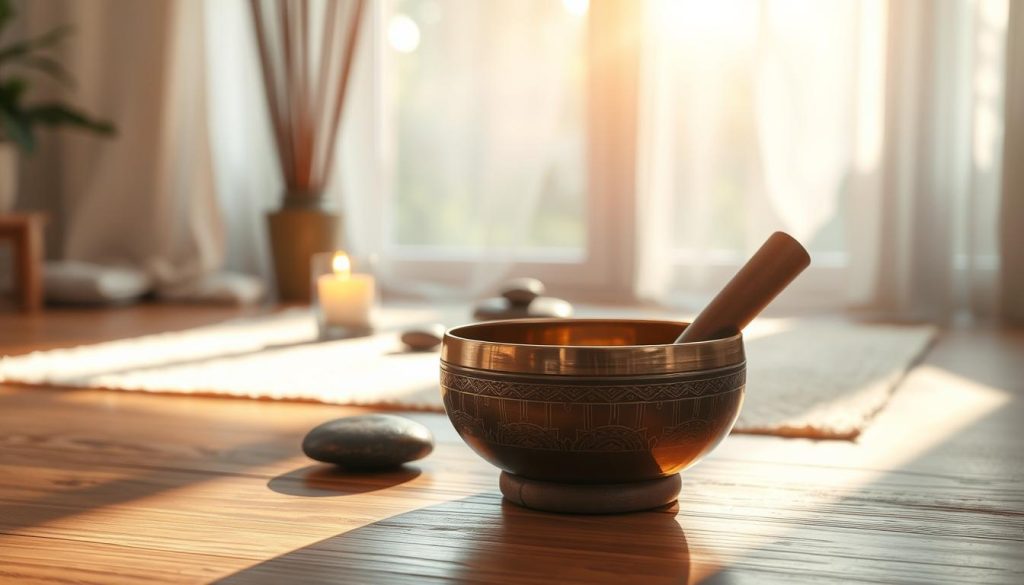
In this article, we explain how these ancient instruments can help restore calm and relaxation. Tibetan singing bowls have existed in Asian traditions for 5,000 years and now appeal to people worldwide.
Each bowl has a unique sound quality. This characteristic influences your meditation experience and mental well-being.
A suitable mallet releases the vibrations needed for effective practice. Tangible benefits for the body and mind can be observed.
We also examine how bowls harmonize your personal sound environment. To learn more, read a study on singing bowls documenting stress reduction.
This article aims to clarify the practice and help you prepare for your first session with confidence.
Tibetan singing bowl music: what are its effects on relaxation?
For many people, the singing bowl’s sound becomes a focal point that facilitates deep relaxation.
The Tibetan bowl has become an essential instrument for those seeking genuine relaxation. Its resonance creates an atmosphere conducive to inner calm.
In practice, bowls serve as anchors for attention during periods of stress. Listening carefully to their vibrant sounds helps redirect attention away from turmoil and toward a stable sound.
A well-chosen bowl can also help release physical tension. Its harmonics encourage slow breathing and promote noticeable muscle relaxation.
Lastly, using bowls provides a simple way to introduce silence into a noisy daily life. Relaxation arises directly from sustained listening and attention to the present moment around the bowl.
Origins and cultural heritage of singing bowls
Singing bowls are part of an ancient heritage rich in artisanal expertise.
History and production
This article traces the history of Tibetan bowls and their transmission through the ages. The objects are traditionally hand-forged by local artisans.
The process requires extreme precision. Every hammer blow and finishing detail affects the acoustic quality.
Symbolism of the metals
The bowls are said to be made from an alloy of seven metals: gold, silver, copper, iron, tin, lead and mercury. In tradition, each metal carries symbolism associated with the planets.
The bowl’s size changes its resonance. A large piece vibrates more slowly and produces deep harmonics, reflecting the quality of this ancestral craftsmanship.
- The bowls are forged from a precise alloy to ensure sonic harmony.
- Each metal adds a tonal color and an energetic meaning.
- Size and finish determine the richness of the harmonics.
| Aspect | Importance | Effect on sound |
|---|---|---|
| Composition (alloy) | High | Tonal color and resonance duration |
| Handcrafting | High | Purity of the harmonics |
| Size | Medium | Fundamental frequency |
| Finish | Medium | Clarity and projection |
Understanding the origins of these instruments helps us better appreciate their cultural and sonic value. The bowls remain objects steeped in history, used for millennia for their acoustic properties.
Sound mechanisms and the effects of vibrations on the nervous system
The vibrations emitted by a bowl directly modulate nervous-system activity.
Striking the rim with a mallet creates complex harmonics. These sounds stimulate the parasympathetic nervous system and foster a state of calm.
The frequency of 432 Hz is often cited for its soothing qualities, although the scientific evidence remains disputed. What matters most is the experience: each instrument’s distinctive timbre acts on the body through vibration.
- Sound waves propagate and modulate mental alertness.
- Harmonics reduce agitation and help regulate the nervous system.
- Different frequencies may alter the state of consciousness.
In practice, repeated use of Tibetan bowls influences the perceived level of stress. To explore modern applications further, learn about sound therapy.
Potential benefits for the body and mind
The rich vibrations of singing bowls promote a perceptible sense of calm in the body and mind.
Stress reduction
Immediate stress reduction
A 2016 study conducted at the University of California, San Diego found a 37% reduction in tension after one session. The sounds and vibrations take effect within minutes.
Better sleep
Supporting a sleep routine
Regular practice helps the body enter a calmer state. This effect makes it easier to fall asleep and improves the quality of nighttime sleep cycles.
Meditation and mindfulness
A meditation tool
Adding a bowl to a yoga or meditation session strengthens attention. The mind grows calmer, making emotions easier to manage.
- Benefits: mental relaxation and reduced tension.
- Acts on the nervous system to release accumulated tension.
- Improves overall well-being through regular practice.
| Benefit | Observed timeframe | Effect |
|---|---|---|
| Stress reduction | A few minutes | Measured reduction (37%) |
| Sleep | After several weeks | Better sleep quality and a stronger routine |
| Meditation | Immediate and cumulative effect | Greater attention and mental calm |
To explore these benefits further, read this article about sound-based wellness practices.
Differences between metal and crystal bowls
Metal and crystal transform the listening experience: one brings warmth, the other clarity.
Metal Tibetan bowls offer an experience rich in harmonics. Their sound contains multiple layers that fill the space and envelop the body.
Crystal versions emphasize purity and clarity. They project distinct tones that seem to engage concentration more directly.
Each instrument has different effects on breathing and bodily sensations. Metal creates a perceptible warmth, while crystal produces an impression of sonic precision.
The way the room is arranged may vary according to this choice. Metallic sounds provide diffuse depth. Crystal sounds open up the space and capture attention.
- Warmth (metal): complex harmonics and long resonance.
- Clarity (crystal): pure timbre and crisp attack.
- Your choice depends on your practice and the desired effect.
For a detailed comparison of their characteristics and help choosing, read this comparison of crystal and metal bowls.
Essential criteria for choosing your instrument
Size and timbre largely determine the sound experience and how it feels in the body.
Size and frequency
Small models (10 to 15 cm) produce higher-pitched sounds. They are suitable for short sessions and concentration.
Large models (20 to 30 cm) produce deep bass tones. They create an enveloping vibration for relaxation and well-being.
Handling and accessories
A good instrument should rest comfortably in your hand. This makes practice and meditation easier.
The mallet remains crucial. Its material and size influence the timbre and quality of the vibration.
- Choose according to your intended use: yoga, meditation or relaxation.
- Select metal or crystal according to the effect you want.
- Test contact with the body to feel the effect of the vibrations.
| Criterion | Why it matters | Recommendation |
|---|---|---|
| Size | Determines the depth of the timbre | 10 to 15 cm for high notes, 20 to 30 cm for low notes |
| Handling | Comfort during practice | Hold the bowl in your hand to test it |
| Mallet | Changes the attack and resonance duration | Try wood, felt or leather |
| Material | Creates a different vibrational texture | Metal = warm harmonics, crystal = clarity |
Fundamental techniques for making your bowl sing
Producing and sustaining resonance requires precise, attentive movements.
The striking method
Place the instrument on your palm or a stable cushion. Gently strike the rim with a wooden or felt mallet.
The movement should be short and controlled. Aim for a clear attack to release the harmonics and reveal the timbre. Within a few minutes, you will feel the vibration spreading through your body.
Circular rubbing
Hold the mallet lightly and rub it around the rim with a steady circular motion. Adjust the pressure according to the size and material: crystal and metal respond differently.
This technique requires practice to maintain a constant vibration. Stay relaxed: tension in the body interrupts the resonance.
- Mastering the strike releases pure harmonics.
- Circular rubbing requires patience to produce a continuous sound.
- Each instrument responds to the practitioner’s movements.
- Good technique makes a meditation session richer and more stable.
Incorporating bowls into a wellness routine
Introducing these instruments into your daily habits transforms a simple break into a restorative ritual.
Before each session, turn off all your devices for 15 minutes to support concentration. Create a dedicated space for yoga or meditation. A quiet place helps the mind slow down.
Begin with 10 minutes of practice. A short session is enough to ease stress and bring the body back into balance.
- Use the mallet gently to produce a stable vibration.
- Keep your hand relaxed so the instrument can resonate freely.
- Place the object in the center of your mat or cushion to strengthen your intention.
In daily life, this ritual becomes a reliable tool for maintaining well-being. It helps the mind return to the present moment and supports sleep quality when practiced regularly.
To better understand the benefits and extend your practice, read this overview of the benefits of Tibetan singing bowls.
Advanced practices for deep sound immersion
Exploring more precise techniques makes it possible to observe vibrations.
Filling the bowl one-third full of water lets you see the waves directly as geometric patterns appear and evolve.
Technique: place the instrument on a stable surface, hold it firmly with one hand and apply the mallet precisely to the rim.
Within 10 minutes, this practice can influence the nervous system and help reduce stress. The sounds propagate as vibrations, gradually calming the body and mind.
Combining crystal or metal with water changes the color of the harmonics. The result makes a meditation or yoga session more immersive.
- Visualization: patterns on the water reveal the vibrations.
- Immersion: an altered state achieved through the power of sound.
- Quick practice: a few minutes are enough to feel the effect.
Care tips for preserving acoustic quality
Simple care preserves the purity of the vibrations and the quality of the timbre.
Cleaning: wipe Tibetan bowls with a soft cloth after every use. For metal bowls, avoid abrasive products that can damage the alloy and alter the vibration.
For a crystal bowl, use a dry cloth and handle it gently. Temperature changes can cause microcracks.
Storage: keep your instruments in a case or on a stable cushion. This prevents impacts that could alter their dimensions and tonal color.
“An instrument that is properly maintained makes every session more effective for the body and mind.”
- Check the mallet regularly: the wood or felt must be clean.
- Adapt your precautions to the alloy and size.
- Avoid prolonged moisture to preserve the timbre.
| Item | Frequency | Practical advice |
|---|---|---|
| Cleaning | After every use | Soft cloth, no abrasives |
| Storage | At all times | Padded case or cushion |
| Mallet inspection | Monthly | Replace it if worn or dirty |
Conclusion
Conclusion
Regular use can therefore transform a simple break into a truly restorative ritual.
This article shows that singing bowls are a simple tool for improving well-being. Meditating with a Tibetan bowl helps reduce everyday stress and promotes lasting relaxation.
We have presented techniques, observed benefits and the importance of sound quality in producing effective vibrations. Incorporating these sounds into your routine can help maintain a consistent sense of serenity.
To explore the bowls’ properties and benefits and enrich your practice, read the suggested resource.