
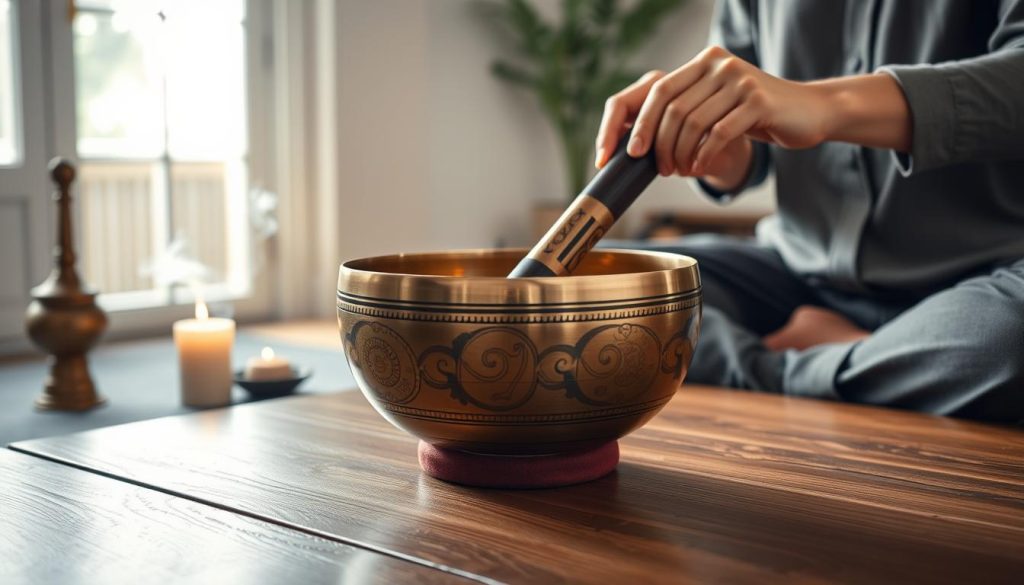
Discover a simple practice for calming the mind in just a few minutes. A 10-minute evening routine is often enough to prepare for sleep and establish lasting calm.
This experience is based on listening to sounds and being present in the moment. By making your Tibetan singing bowl sing once a day, you create an accessible ritual, even with a busy schedule.
This guide takes you through each step to help you adopt the right posture, master the movement, and choose the length of a short session. The goal is to promote relaxation and uncomplicated meditation.
With regular practice, this small sound instrument turns every moment into a restorative break. You will quickly notice its effects on your attention and serenity.
Understanding how singing bowls work
Behind every vibration lies a Himalayan tradition and specific acoustic properties.
Origins and transmission
Singing bowls come from the Himalayas and were used in monastic settings.
They were often forged from alloys containing seven metals: gold, silver, mercury, copper, iron, tin, and lead.
This composition influences the instrument’s tone color and durability.
Principles of resonance
A bowl produces a fundamental frequency that generally ranges from 110 to 660 Hz.
Its resonance combines this foundation with complex harmonics. Together, they create rich, evolving sounds.
“Each three-dimensional vibration travels through the air and the body, offering a unique sound experience.”
- Singing bowls emit vibrations that fill the space.
- The quality of the metal affects the richness of the harmonics.
- Understanding these principles helps you appreciate the sounds more fully during moments of relaxation.
To explore the practice and the use of a singing bowl in greater depth, read our practical guide.
How to use a Tibetan singing bowl correctly
Good contact between the mallet and the surface transforms the bowl into a source of soothing vibrations.
Start gently. Place the bowl on your palm or on a stable cushion. Touch the rim with the mallet, then make a slow circular movement to make the instrument sing.
Each bowl has a unique sound signature related to its alloy and size. Take the time to listen and adjust the pressure to avoid rattling.
- Use a steady, fluid movement.
- Vary the speed to find the best resonance.
- Practice for a few minutes each day to improve.
| Step | Action | Expected result |
|---|---|---|
| Placement | On the palm or on a cushion | Stable resonance |
| Contact | Circular rubbing | Continuous sound rich in harmonics |
| Adjustment | Change the angle and pressure | Reduced rattling |
By practicing regularly, you will discover how these instruments transform the soundscape and create a serene space. Singing bowls reveal their potential through patience and attentive listening.
Choosing your instrument and accessories
Choosing a suitable bowl makes learning easier and enriches the sound experience.
For beginners, size matters. A diameter of 15 to 20 cm provides versatility and is easy to handle. This size helps you control the movement and explore the harmonics.
Essential accessories
A suitable set of accessories improves resonance and comfort. Choose a stable cushion and a wooden or leather-covered stick to vary the timbres.
- Keep your hand relaxed: gripping the rim too firmly muffles the sound.
- Aim for at least 30 seconds of resonance after a gentle strike to assess the instrument’s quality.
- Investing in high-quality singing bowls gives you access to a richer range of harmonics.
| Size (diameter) | Approximate resonance | Recommended accessory | Use |
|---|---|---|---|
| 15–20 cm | ≥ 30 s | Cushion + wooden or leather-covered stick | Versatile use, suitable for beginners |
| 20–25 cm | 30–45 s | Thick cushion | Long sessions |
| > 25 cm | 45 s or more | Soft leather-covered stick | Deep meditation practice |
To find suitable mallets, discover our selection of wooden mallets and experiment with different textures to refine your listening.
Preparing a space conducive to relaxation
A thoughtfully arranged space encourages concentration and extends the resonance during a session. Choose a quiet, comfortably warm, draft-free room, and plan a session of 10 to 20 minutes if you are a beginner.
Place the cushion in the center and set your singing bowl on it. A suitable cushion allows the vibrations to flow and prevents a hard surface from muffling the sound.
Before each session, make sure the space is clear. Leave enough room to handle the bowls without striking fragile objects.
- Cleaning: wipe the bowl’s rim to improve the mallet’s grip.
- Comfort: choose a chair or cushion that lets you sit without tension.
- Consistency: daily meditation with your bowls strengthens your sense of grounding and reduces stress.
“A simple, stable setting enhances the quality of the vibrations and the depth of relaxation.”
Adopting the ideal posture to release the vibrations
Adopting a suitable seated posture allows the singing bowl’s vibrations to travel through the body.
Body position
Sit comfortably, with your back straight and your shoulders relaxed. Calm breathing helps steady the movement and maintain concentration.
Place the cushion in the center to support the bowl. If you prefer a chair, keep your feet on the floor and your pelvis in a neutral position.
Hand position
Support the bowl in your open palm, with your fingers slightly spread so they do not muffle the vibrations of the bowl’s wall.
Hold the stick like a pen and keep your wrist relaxed. The movement should be fluid and the angle consistent to produce a steady vibration.
If your hand becomes tired, use a cushion to stabilize the bowl. Keep contact to a minimum: excessive pressure reduces sound quality.
“A simple posture and a light grip release the full richness of the harmonics.”
Mastering the striking technique for a clean attack
A clean strike transforms the sound’s attack and defines the note’s tone color.
The strike should be crisp and brief. Give the bowl a sharp tap near the rim, then let the stick rebound immediately. The rebound creates a clear attack without muffling the vibrations of the bowl’s wall.
Hold the stick like a pen and use a swinging motion from the wrist to keep the movement precise. Hold the bowl in your palm with your fingers spread so the metal can vibrate freely.
- Strike: a short, sharp tap near the rim for a clean attack.
- Movement: swing from the wrist while maintaining a consistent angle.
- After striking: gently rubbing with a wooden or leather-covered stick enriches the harmonics.
| Element | Action | Result |
|---|---|---|
| Contact | Sharp tap near the rim | Clear note, controlled volume |
| Hold | Open palm, fingers spread | Optimal propagation of vibrations |
| Tool | Stick held like a pen | Precise strike, natural rebound |
“The quality of the note depends on precise contact and controlled volume, creating a harmonious ten-minute session.”
Learning the rubbing motion that makes the bowl sing
A well-guided rubbing motion produces a pure vibration and a deeply absorbing listening experience. This technique combines an initial strike, a consistent angle, and a fluid movement. It makes the bowl sing and establishes a continuous note for meditation.
Starting impulse
Begin with three gentle strikes to start the note. Then move immediately into a steady rubbing motion.
Basic cycle: 3 strikes, 20 seconds of rubbing, 20 seconds of listening.
Angle and pressure
Hold the stick almost perpendicular to the rim, at an angle close to 90 degrees. Keep the pressure consistent: too much muffles the vibrations of the bowl’s wall, while too little fails to activate the harmonics.
Fluid movement
Use your arm and shoulder for the rubbing motion, not just your wrist. Keep the speed slow and steady to prevent rattling.
| Element | Action | Duration / effect |
|---|---|---|
| Strike | Gentle tap near the rim | 3 times → starts the note |
| Rubbing | Slow rotation with the stick | 20 s → stable vibration |
| Listening | Attentive silence | 20 s → awareness of the harmonics |
“Consistent contact and a slow movement reveal the true quality of the harmonics.”
Solving sound problems and rattling
Rattling can quickly spoil a session; here is how to identify its common causes and correct them.
Start with the surroundings. Make sure your singing bowl is not resting on a hard surface that absorbs its vibrations. A suitable cushion releases the harmonics and improves sound quality.
Next, observe your movement. Rubbing too quickly or at an uneven speed produces an unstable sound. Slow down and maintain consistent pressure on the rim to stabilize the note.
The bowl’s size affects its pitch: a small bowl will produce a higher note. If the sound rattles, reduce the force of the strike and adjust the contact angle to prevent friction against the bowl’s wall.
- Hard surface → use a cushion.
- Speed too high → slow down the rubbing motion.
- Strike too forceful → lower the volume for clear resonance.
“Precise contact and light pressure on the rim reveal the true quality of the harmonics.”
Incorporating bowls into a daily routine
A ten-minute sound ritual transforms a break into a genuine meditation session.
Session structure
Begin in a seated position with your back straight. Take a singing bowl and place it on your palm or on a cushion.
1) Gentle strike: a clean attack near the rim to start the note.
2) Make the bowl sing: continue with a steady rubbing motion using a wooden or leather-covered stick. Maintain a constant speed and light contact.
3) Listening: leave 20 to 30 seconds of silence after each rubbing phase. These moments allow the body to absorb the vibration and harmonics.
- Repeat the cycle 2 to 3 times for a 10-minute session.
- Vary the size of the bowls to create smooth transitions between notes.
- Control the volume and adjust the speed to preserve sound quality.
“Consistency in your practice stabilizes the harmonics and heightens the calming effect.”
To deepen your routine and learn how to use each tool, read our practical guide to using a singing bowl.
Exploring the benefits of sound therapy
A bowl’s harmonics provide a sound-based focus that helps calm the mind.
Sound therapy uses singing bowls to induce a state of deep relaxation similar to sound-guided meditation.
The bowl’s vibrations help release tension that has accumulated in the body. After a few minutes, they promote an overall sense of well-being.
Exploring the bowls’ harmonics can help create harmony in a living space. It often improves sleep quality and the ability to refocus.
- A regular 10-minute session steadies the mind.
- Controlled rubbing produces a continuous note conducive to attentive listening.
- Reported effects include improved concentration and lasting calm.
“A short, consistent practice transforms the perception of stress through harmonics and vibrations.”
Precautions and safety advice
Sound practice is powerful; a few simple precautions ensure a safe experience.
Before each session, check the condition of the metal and the size of your instrument. A cracked bowl loses sound quality and may vibrate unpredictably.
Medical contraindications
Singing bowl practice should be approached with caution if you have a neurological condition, a pacemaker, or heart problems.
If in doubt, consult a healthcare professional before incorporating bowls into your relaxation routine.
Sound sensitivity
Protect your ears: maintain a moderate speed and volume while rubbing. Rubbing too quickly or making abrupt contact with the rim may be painful.
Keep your hand relaxed and avoid gripping the rim. Use a cushion to support the bowl and choose a suitable wooden or leather-covered stick.
- Control the volume and angle to limit rattling.
- Check the position of your fingers and hand to preserve the vibrations and note.
- Limit the session to ten minutes if you are a beginner.
“A simple check before each use protects the instrument and ensures the calming effect of its harmonics.”
Conclusion
Progress comes through repetition and consistent attention to the movement. Mastering the art of making your instrument sing requires patience, rhythm, and precise positioning.
By applying the striking and rubbing techniques, you turn every session into a moment of calm. Take time to listen between sounds: silence amplifies the effect of the bowl’s song.
With a good bowl and regular practice, you will produce richer harmonics from one session to the next. Continue exploring the harmonics of your bowls to deepen your experience.
To take your meditation with bowls further, read our dedicated guide to meditation with singing bowls.