
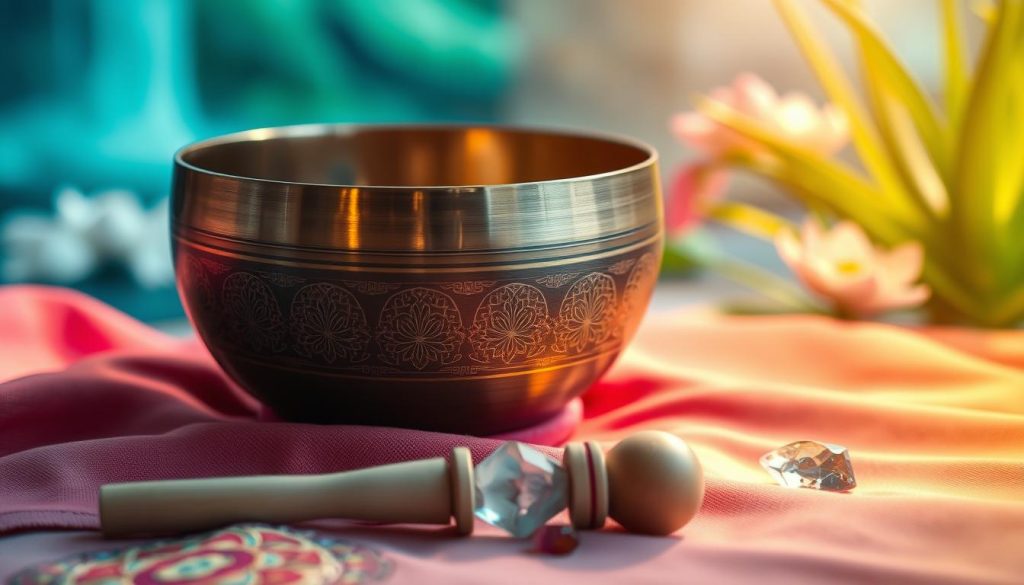
The Tibetan singing bowl is an ancient instrument that has been used for millennia to support meditation and inner well-being.
Its vibrations help the body return to a state of calm through deep, soothing sound waves.
This guide explains how to select a bowl suited to your energetic needs. The right choice makes your practice more effective and promotes deeper relaxation.
Depending on their material and tuning, bowls can target a specific chakra or offer a broad sound spectrum. Trying different frequencies helps you feel their effects on the body.
To learn more about the relationship between pitches and receive practical advice, see this useful resource on how to choose the right note.
Understanding How Singing Bowls Vibrate
A singing bowl creates audible and tangible waves that can be felt far beyond the ear. These vibrations interact with the body and contribute to a form of energetic harmonization.
Origins and History
Singing bowls were once used in monasteries, where they helped monks focus their attention. These traditional practices date back several millennia and form part of meditation practice.
The Principle of Acoustic Resonance
Resonance turns movement in the air into sound waves. Each Tibetan singing bowl has a unique signature shaped by the metals used and its handcrafted construction.
“The vibrations penetrate the tissues and bring about deep relaxation.”
- Alloy: often seven metals, each associated with a planet and a chakra.
- Resonance: interaction between sounds and the sensory organs.
- Regular practice: synchronization of brain waves.
| Element | Effect | Application |
|---|---|---|
| Sound signature | Unique and identifiable | Selection based on listening preferences |
| Resonance | Penetration of tissues | Immediate relaxation |
| Composition | Metal alloy | Influence on frequency |
To explore the relationship between sound and practice in greater depth, read a detailed guide to tuning and use.
Tibetan Singing Bowl for Chakras: Which Note Should You Choose?
Each pitch acts like a key that opens a specific energy center.
The choice of note directly affects the frequency produced and the focus of the energy work. Singing bowls often follow the diatonic scale, making it possible to work on each chakra with recognizable sounds.
Some bowls can be tuned to semitones. These provide additional precision during sessions and support better alignment of the energy centers.
- Matching the note to your personal intention improves the effectiveness of the practice.
- Trying several pitches helps you feel the differences between their vibrations.
- Think of frequency as the language of the body’s energy centers.
“Selecting an appropriate note optimizes the therapeutic benefits of your instrument.”
For practical advice and detailed correspondences, see the dedicated page on how to choose the right note.
How Frequencies Influence the Body and Mind
The frequencies produced by a bowl directly affect physical and mental states. The pitch of a sound, expressed in hertz, determines how the eardrums perceive it and how the nervous system responds.
In practical terms, the note A has been standardized at 440 Hz since 1975. C corresponds to 261.626 Hz and G to 391.995 Hz. These reference points help explain why some notes seem to promote grounding, while others feel lighter and more ethereal.
The Difference Between Low and High Sounds
Low sounds, produced by larger bowls, create a grounding effect and stabilize the body. They foster a feeling of physical safety and help you reconnect with the root chakra.
By contrast, the high sounds produced by smaller singing bowls encourage spiritual elevation and mental clarity during meditation. They stimulate the upper energy centers.
- Physical effect: synchronization of biological rhythms.
- Mental effect: less mental fog and better concentration.
- Practice: combine low and high sounds for comprehensive work on the body and mind.
“Each instrument acts like a sonic magnifying glass: its frequency directs intention and the body’s responses.”
To explore the subject further and find the right instrument for your practice, read this practical guide on how to choose the right note.
Understanding Musical Notes and Their Energetic Benefits
Each musical note carries an energetic quality that directly influences how we feel. Here is how the different pitches are distributed among the body’s energy centers.
Low Notes for Grounding
C resonates with the root chakra and promotes solid grounding. Low sounds stabilize the body and posture.
They help restore a sense of safety and physical presence.
Midrange Notes for Balance
D, E and F support the sacral center, solar plexus and heart. These notes stimulate creativity, confidence and emotional openness.
In practice, combine these frequencies during a session to harmonize the central part of the body.
High Notes for Spirituality
G, A and B elevate awareness. These notes support communication, third-eye intuition and connection at the crown of the head.
Crystal singing bowls produce very pure sounds. They target a specific center with great clarity.
“Pitches direct intention and facilitate focused work on each chakra.”
The Decisive Role of Materials and Size
An instrument’s material composition largely determines its tone and depth. A seven-metal alloy provides rare sonic richness and complex harmonics.
Size has a physical role: every additional centimeter of diameter lowers the frequency by approximately 5 Hz. A larger diameter therefore promotes low sounds and grounding, which are useful for the root chakra.
Hand-hammered bowls have irregularities that enrich their harmonics. Cast models offer a more uniform spectrum. A weight of 800 g to 2 kg provides an indication of metal density.
Quartz crystal versions produce higher sounds. They are suitable for stimulating the third-eye chakra and crown chakra, while metal alloys reinforce work on the solar plexus and heart chakra.
“The fundamental note accounts for nearly 70% of the sound power and guides its impact on the body.”
To learn how to choose a bowl based on your intention—grounding, elevation or balance—consider its size, material and construction.
Ways to Identify Your Instrument’s Note
Measuring a bowl’s sound reveals its true vibrational signature. Begin with a simple, reliable method before refining your practice.
Using Mobile Apps
Apps such as Spectroid (Android) or Tuner Pro (iOS) display the frequency in hertz. Place the device about 30 cm from the bowl’s rim and gently strike the bowl with a felt mallet.
Calibrate the microphone before taking the measurement to obtain a reliable reading.
Careful Listening and Practice
Train your ear: after eight weeks of regular practice, you will be able to distinguish the fundamental note from the secondary harmonics.
A felt mallet emphasizes the fundamental, while a hard striker brings out the harmonics.
“Every hand-hammered instrument is unique; its size does not always indicate its pitch.”
Practical example: an 18 cm Jambati often produces F-sharp (approximately 370 Hz), with harmonics at 740 and 1,110 Hz. To learn more, see this tuning guide.
Why the Reference Frequency Is Essential
An instrument’s base tuning changes the character of all its notes and directly influences its effect on the body and energy centers.
The 432 Hz reference frequency is often preferred by practitioners because it is associated with the golden ratio. It creates a softer tone that is perceived as more “natural.”
The modern 440 Hz standard, meanwhile, has remained the most widely used reference since 1975. This difference changes the pitch of every note in the scale and therefore its perceived effect on each chakra.
Choosing a bowl tuned to 432 Hz may encourage deeper meditation and intense relaxation. Many people report feeling grounded and in harmony with nature.
Understanding the reference frequency helps you adapt an instrument to your energetic needs. Each person may prefer 432 Hz or 440 Hz; guided listening remains the best test.
“The reference frequency determines the pitch of the notes and their impact on the energy system.”
- 432 Hz: a soft, natural tone recommended for deep meditation and crown-chakra work.
- 440 Hz: the modern standard, compatible with Western music.
The Limits of Changing a Bowl’s Pitch
Permanently changing a bowl’s pitch is almost impossible. Its fundamental note depends on its molecular structure, size and wall thickness.
Partially filling the instrument with water can lower the frequency by 1 to 3 Hz. This technique is temporary and alters the purity of the sound.
Professional hammering is possible, but it carries a risk of irreparable cracking and costs between €50 and €120.
92% of users prefer to buy a new instrument rather than attempt a technical adjustment. This is often safer for meditation practice and chakra work.
Quartz crystal bowls are particularly sensitive. Any intervention changes their pure resonance and may impair their effect on the crown or sacral chakra.
“To obtain low or higher sounds, it is better to choose an instrument designed for those frequencies.”
In summary, choose a suitable bowl when you buy it instead of trying to change its note. This preserves its sound quality and its effectiveness for the body and energetic heart.
Conclusion
Ending your practice with a clear intention helps anchor the vibrational effects in your energy centers.
Choosing a suitable bowl remains a personal process. Consider its fundamental note and the quality of its material.
This guide has helped you identify useful frequencies for the root chakra, sacral chakra and heart chakra. It also presents options for the solar plexus, throat, third eye and crown.
Experiment. Active listening during meditation reveals which instrument meets your needs. Then share your discoveries with other enthusiasts. A quality instrument provides lasting harmonization.