
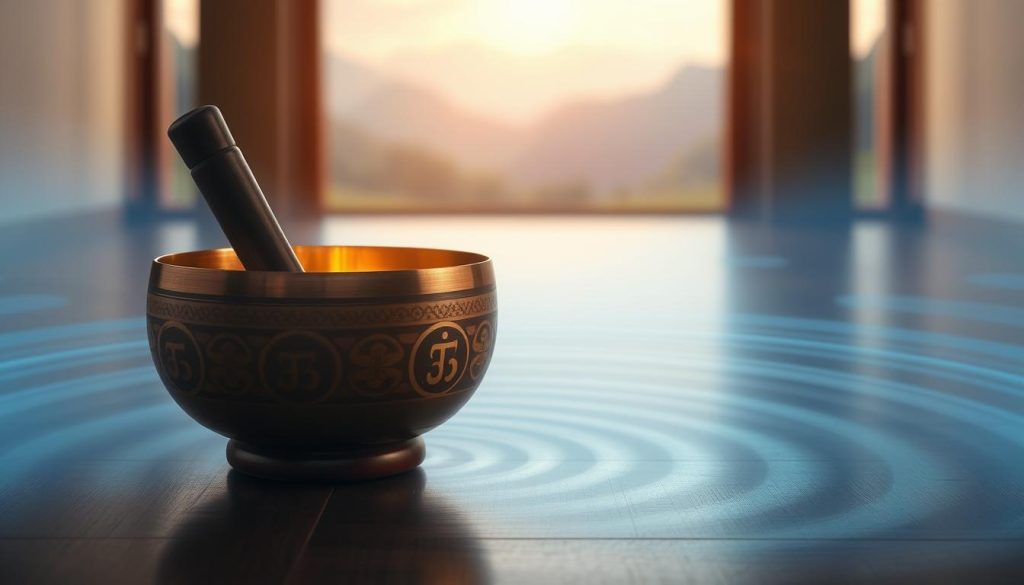
Why is this sound so intriguing? Since antiquity, traditions and practitioners have observed a connection between certain harmonics and human well-being. Pythagoras already noted the relationship between numbers and sounds, and the relationship between 4, 3 and 2 leads to the number nine, a symbol of completion.
Today, modern 440 Hz tuning has overshadowed this alternative. Yet music therapists and healers are rediscovering a gentler, brighter resonance for meditation and daily practice.
This guide explores the symbolic and practical foundations, as well as the scientific debates. To learn more about the origins of these ideas and their contemporary uses, read our detailed analysis in the complete guide to tuning.
As you read on, you will discover how this instrument can transform your routine through a resonance perceived as more natural and attuned to ancient cycles.
432 Hz Tibetan singing bowl: what does this frequency really mean?
Interest in alternative tuning stems from its supposed affinity with nature and the human body.
The connection with the golden ratio links the frequency to a proportion known as “phi,” often associated with natural cycles. Many people claim that this basis creates a gentler, more harmonious resonance.
The body absorbs sound waves. A singing bowl may therefore stimulate the chakras and promote relaxation of the body and mind. A metal instrument produces a dominant note and complex harmonics.
By contrast, crystal bowls (99.9% quartz) produce a very pure note. This sound quality facilitates meditation and allows great precision in the notes used to work with the heart chakra.
- An instrument tuned to 432 Hz provides a more direct connection with natural vibrations.
- The harmonics of metal bowls create a rich texture, while crystal bowls offer a more stable sound quality.
- When comparing 432 Hz and 440 Hz, many practitioners report reduced stress and better relaxation.
To choose according to your needs, read our complete tuning guide.
The historical and symbolic origins of the vibration
Since antiquity, numbers and sounds have served as keys to understanding human harmony.
The legacy of Pythagoras
Pythagoras expressed the relationship between intervals and notes mathematically. His Pythagorean tuning laid the foundations for using simple ratios in music.
Ancient instruments used these ratios to create clear harmonics. A well-tuned instrument therefore produces a resonance perceived as natural.
The symbolism of the number nine
The number 432 reduces to nine when its digits are added together. Nine symbolizes completion and spiritual awakening in several traditions.
Civilizations such as the Egyptians and Sumerians recognized the effect of sounds on the energy of the body and mind.
- Singing bowls are idiophones: physical vibration produces the note and its harmonics.
- The 432 Hz frequency creates a connection with nature and the cosmos.
- Traditionally, notes were chosen to balance the chakras and support meditation.
Understanding the physics of sound resonance
The laws of acoustics explain why the sound persists after contact with the mallet.
The range of frequencies audible to humans extends from 20 to 20,000 Hz. Singing bowls often cover a range of 110 to 660 Hz, which lies well within this interval. Resonance refers to the sound that persists after the rubbing has stopped.
Idiophones operate according to a physical principle: vibration of the wall creates waves in the air. Diameter, density and thickness influence the pitch of the note.
Large models, such as Jambati bowls, vibrate more easily and produce deep harmonics. Proper use of a mallet maximizes resonance and helps soothe the body and mind.
- The 432 Hz frequency is measured in cycles per second and belongs to the language of music.
- Fundamental harmonics may be associated with the chakras for energy work.
- Modern science shows that these vibrations influence the nervous system and promote relaxation.
Therapeutic benefits for the body and mind
Musical vibrations affect the brain and body, encouraging a state of relaxation and openness.
Stress reduction
Listening to tuned sounds calms the nervous system. Studies and practitioners have observed reduced anxiety through the stimulation of alpha waves.
In practice, a short session is often enough to experience greater relaxation and a release of tension.
Improved concentration
One or more well-played singing bowls guide the brain toward rhythms conducive to concentration.
The harmonics create a stable resonance that helps sustain attention during work or meditation.
Regular practice opens the mind and fosters a connection with inner energy.
The heart chakra may be balanced through certain notes, strengthening compassion and emotional well-being.
- Stress reduction is a major benefit of focused listening.
- The bowl’s vibrations act on the body to release tension.
- Daily meditation improves sleep and emotional stability.
To learn more about tuning parameters and their effects, read our tuning guide.
How to incorporate this frequency into your daily practice
A few adjustments are all it takes to bring soothing vibrations into your daily sessions.
Meditation: start with 5 to 10 minutes a day using tracks tuned to 432 Hz. This enriches mindfulness and steadies the breath.
At work, play gentle sounds discreetly to reduce stress and improve concentration. Breaks become more restorative.
If you are a musician, tuning your instruments to the same reference lets you experience harmony between the instrument and the listener. Tuning forks and therapeutic sound devices complete the toolkit.
Finally, use mobile apps to access these sounds at any time. They offer guided sessions and chakra-based settings tailored to your needs.
- Define your needs before buying an instrument.
- Favor regular practice, even if sessions are short.
- Target notes according to the chakras for focused work.
| Use | Tool | Recommended duration | Main benefit |
|---|---|---|---|
| Morning meditation | Audio track / singing bowl | 5–15 min | Grounding, clarity |
| Concentration at work | Background music | Short sessions | Stress reduction |
| Targeted therapy | Tuning fork / sound device | 20–40 min | Chakra balance |
To choose the right tools and explore tuning settings in greater depth, read our tuning guide.
Differences between reference frequencies
Comparing tuning references reveals how a simple adjustment changes the entire sound palette.
The debate between 432 Hz and 440 Hz
The standard adopted in 1975 established 440 Hz as the international reference for modern music. Its industrial adoption standardized the notes used worldwide.
Many describe 432 Hz as gentler and brighter. In practice, a C tuned using a 440 Hz reference vibrates at 261.6 Hz, while with a 432 Hz reference it reaches 256.9 Hz.
Practical consequences:
- Changing the reference alters every note in the scale and the overall resonance.
- Singing bowls tuned to 432 Hz are often preferred for meditation and chakra work.
- Harmonics vary according to the reference, which influences the listening experience.
- Apps now make it easy to compare these frequencies and adapt your sessions.
Understanding these nuances helps you choose a singing bowl or sound range that suits your relaxation and musical-practice needs.
Choosing the right instrument for your needs
Choosing the right instrument depends on its intended use and how its note resonates with you.
Precision or tonal richness?
Crystal bowls, made of 99.9% quartz, produce a pure note. They are ideal for targeting a chakra and working clearly with a precise frequency.
Metal models produce a dominant note accompanied by rich harmonics. They are better suited to overall work with the body’s energy.
Diameter affects pitch: the larger it is, the deeper the sound. Thick bowls produce higher frequencies than thin bowls.
- Assess your needs before buying: targeted meditation or general sessions.
- Try several instruments to discover which note resonates with you.
- Remember that once made, the instrument retains its pitch: it cannot be changed.
| Type | Characteristic | Recommended use |
|---|---|---|
| Crystal (99.9%) | Pure, stable note | Targeted chakra work |
| Metal | Dominant note and harmonics | General sessions, relaxation |
| Large diameter | Deep sound | Deep meditation, grounding |
| Small diameter | High-pitched sound | Focused work, clarity |
Debunking misconceptions about healing sounds
Before idealizing vibrations, let us examine what science confirms and where it offers a more nuanced view.
The scientific reality
Studies show that certain sound ranges resonate with biological parameters in the body. Brain waves (beta, alpha, theta, delta and gamma) respond to sound stimuli and may promote relaxation.
Several frequencies are assigned specific uses: 528 Hz is associated with opening the heart chakra, while 174 Hz is often used to relieve pain and support detoxification.
A well-made singing bowl produces stable harmonics. Spectrum-analysis apps now make it possible to check the frequency of your instruments and dispel misconceptions.
The limits of sound healing
Sound therapy is an excellent complementary practice for reducing stress and improving meditation, but it does not replace medical treatment for serious illnesses.
It is essential to check the quality of the bowls. Inharmonious sounds may detract from the experience and limit its benefits.
- Each frequency has unique properties; its use depends on your needs.
- The singing bowl acts as a bridge between sound and the mind, encouraging relaxation and connection.
- Remember to check your tools with apps and consult a professional when necessary.
For legal and compliance information, read our legal notice.
Exploring other healing frequencies
Certain notes are assigned specific uses for cleansing and rebalancing energy.
Practitioners use instruments tuned to frequency ranges known for their purported effects. The frequency of 528 Hz is often associated with the heart chakra and described as the “love frequency.”
741 Hz is said to support cleansing and clarity. The 396 Hz frequency is associated with releasing anxiety and guilt.
639 Hz is said to support harmony in relationships. The 174 Hz frequency is often used for bodily detoxification. Matching an instrument to these notes makes it possible to produce therapeutic music rich in harmonics.
- Goal: target a specific need (emotion, relationship or body).
- Method: use crystal singing bowls for high precision.
- Result: energy is believed to flow through the chakras more evenly.
| Target frequency | Main use | Target chakra | Recommended tool |
|---|---|---|---|
| 528 Hz | Love, openness | Heart | Crystal singing bowls |
| 741 Hz | Energy cleansing | Throat / clairvoyance | Pure-tone instrument or tuning fork |
| 396 Hz | Emotional release | Root | Guided session with an audio track |
| 174 Hz | Detoxification | Lower body | Low-frequency sound track |
To learn more and find suitable recordings, explore sacred frequencies and their benefits. Varying your instruments lets you create complete, personalized sessions tailored to chakra work and musical practice.
Tools and methods for measuring your vibrations
Measuring your instruments’ vibrations requires little equipment and helps you understand your practice more clearly. Mobile tools make readings simple and visual.
Mobile apps for spectrum analysis
Spectroid provides real-time analysis and has an excellent reputation (4.6 stars). On iOS, Audio Spectrum Analyzer dB RTA is recommended.
PC Mehanik’s Sound Spectrum Analyzer is popular on Android, while SpectrumView lets you record your sessions and compare readings.
“Using an app turns listening into measurable data.”
Practical tips:
- Isolate the note and record a short passage to obtain a clear reading.
- Thanks to their pure note, the frequency of crystal bowls can be measured easily with Spectroid.
- A calibrated external microphone significantly improves measurement accuracy.
- This method lets you check whether the frequency of your instruments matches your meditation and chakra-work needs.
For reliable results, document your measurements and follow this complete guide when buying or tuning your instruments.
Conclusion
Ultimately, thoughtful use of notes helps direct energy and refine the intention behind each session. Vibrations provide a simple, direct way to calm the mind.
Choosing the right frequency helps target a specific need. A clear note from a singing bowl can shape how you feel and promote a sense of energetic balance.
Experiment regularly. Varying your instruments enriches your practice and reveals which combination of sounds suits you best.
We hope this guide has been enlightening and encourages you to explore sound with curiosity and kindness.