
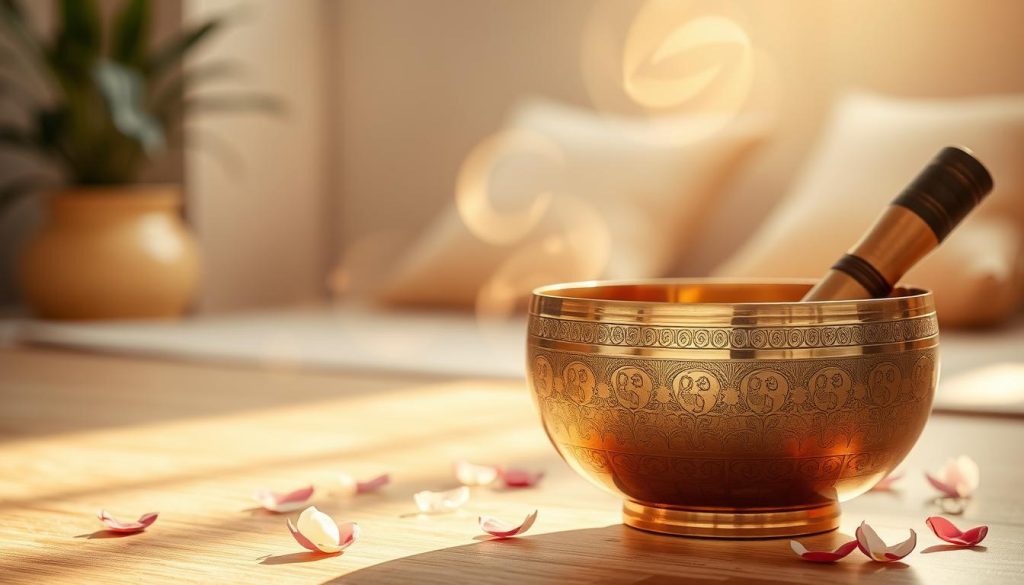
The tradition of sound invites us to slow down in a life that is often lived in haste. This ancient practice uses sound to guide the mind toward lasting calm.
Each bowl emits its own vibration, helping you find an inner point of focus. Its tone turns every session into a moment of peace and mindfulness.
By incorporating a bowl into your routine, you create a sacred place where silence and resonance meet. Today, this tool offers a practical way to improve everyday mental well-being.
The Origins and History of Tibetan Singing Bowls
This sound instrument has roots reaching back more than five millennia in Himalayan history.
Ancient craftspeople made Tibetan singing bowls from a carefully composed alloy. Traditionally, it contained seven metals: gold, silver, iron, mercury, tin, copper and lead.
Each component was associated with a planet. This connection gave the bowl symbolic and ritual significance beyond its acoustic qualities.
The Symbolism of the Seven Metals
The seven elements give each bowl its own vibrational signature. This distinctive alloy affects the pitch, sustain and depth of its sound.
Himalayan Heritage
Originally, these instruments were used in shamanic and healing rituals. Their use has since evolved toward wellness and mindful listening practices.
- Handcrafted construction: every piece has a unique vibrational signature.
- Ancient heritage: more than 5,000 years of cultural history.
- Spiritual dimension: connections with the planets and their symbolism.
| Characteristic | Effect on Sound | Traditional Role |
|---|---|---|
| Seven-metal alloy | Harmonic richness and long sustain | Shamanic rituals and healing |
| Handcrafted construction | Unique vibrational signature | Harmonizing a space |
| Himalayan transmission | Regional variations in tone | Oral transmission and local craftsmanship |
The Benefits of Meditating with a Tibetan Singing Bowl
Using a singing bowl provides a simple yet powerful sonic anchor.
A 2016 American study found that sound therapy significantly reduces stress. The use of a Tibetan singing bowl lowered stress by 62% among participants.
The vibrations produced by the bowl affect brainwaves. They encourage a state of deep relaxation that reaches both the body and mind.
The relationship between sound frequency and well-being is documented. These findings support the traditional benefits associated with the metals used to make every high-quality bowl.
- Measured stress reduction: 62% in clinical trials.
- Lasting effects: the experience continues to soothe after the session.
- Harmonization: vibration helps align the body’s energy centers.
Every experience with a bowl is unique. Through regular practice, you can make this tool part of your routine and improve your overall well-being.
Tibetan Singing Bowls and Meditation: an Ideal Pairing for Recentering Yourself
The vibration of a singing bowl turns a session into an immersive experience. It guides attention toward a fixed point and facilitates deep concentration. This approach helps calm the flow of thoughts without force.
With regular practice, you learn to use sound frequency to release everyday tension. Sustained notes encourage slower breathing and noticeable muscular relaxation.
Many experts recommend sound-assisted practice to people who struggle to quiet their thoughts. The acoustic support acts as an external reference point, directing the mind toward the present moment.
The union of tone and practice creates a bridge between inner silence and soothing sounds. In this way, your everyday space becomes a sanctuary where every note helps you recenter immediately.
How to Choose Your Meditation Instrument
Choosing a suitable bowl affects how its vibrations influence your body and mind.
Metal or crystal bowls: metal bowls offer harmonic richness and a long sustain. Crystal bowls produce a pure, clear sound with a sharper attack. Choose according to your sensitivity to metal and the sound quality you prefer.
The Importance of Size
For effective meditation practice, choose a diameter between 15 and 22 cm. This size is suitable for individual sessions and produces a balanced tone.
- Small bowls produce higher-pitched sounds and suit short sessions or breaks.
- Large bowls offer deep resonance, ideal for profound relaxation.
- Make sure the bowl rests on a suitable cushion to ensure pure, interference-free resonance.
Practical advice: try several models before buying. The right singing bowl should resonate with your body and support your meditation routine.
Preparing a Space That Encourages Relaxation
Create a dedicated corner where every sound has the space it needs to travel.
Temperature: keep the room between 19 and 23°C. This range encourages relaxation and makes breathing easier. A stable temperature helps the bowl produce clear resonance.
Choose a stable floor and place your bowls on a firm support. This prevents unwanted vibrations and preserves the purity of the tone.
Choose an uncluttered environment. A minimally furnished space allows vibrations to travel freely. Remove sources of distracting noise to strengthen the bowl’s soothing effect.
- Create a quiet space with a regulated temperature.
- Place the bowls on a stable base.
- Maintain a minimalist, quiet atmosphere.
Tip: preparing the space transforms the bowl into a tool for change. To deepen your practice and explore complementary approaches, read this guide to Tibetan massage for a serene life, which can be helpful before meditation.
Adopting the Right Physical Posture
Adopting a suitable posture helps sound waves travel throughout the body.
Spinal Alignment
An upright posture is essential if the bowl is to transmit its vibrations without obstruction. Sit on a cushion if necessary to raise your hips slightly.
Align your neck and pelvis. Breathe slowly and feel your spine lengthen. This extension enables the deep breathing that is essential when listening to the sounds.
Physical stability improves your ability to focus on the note. If your back becomes tired, use ergonomic support to maintain a comfortable position throughout the session.
Tip: visualize a line running from your head to your sacrum to maintain a vertical axis during the session.
- Upright posture = better transmission of vibrations.
- Deep breathing = more attentive listening to the bowl.
- Ergonomic support = a tension-free session.
| Element | Effect | Tip |
|---|---|---|
| Spinal alignment | Better distribution of sound | Use a meditation cushion |
| Breathing | Increases receptiveness | Breathe slowly using the diaphragm |
| Support | Helps maintain posture during the session | Ergonomic chair or zafu bench |
To deepen your practice and try these postures, explore a suitable practical workshop.
Techniques for Holding Your Bowl Correctly
How you hold your bowl directly affects its resonance and your listening experience.
Hold the Tibetan singing bowl gently in the palm of your hand without pressing against its sides. Contact should be minimal so that you do not dampen the vibration.
The recommended method is to place your open palm beneath the bowl without gripping it. This position allows the metal to vibrate freely and produce a pure tone.
If the bowl is too heavy, place it on a suitable cushion instead of straining your hand. The cushion preserves sound quality and makes the bowl easier to use during longer sessions.
Make sure the bottom remains free from contact. Hold the wooden mallet firmly but without tension so that you can strike or rub the bowl without losing control of the movement.
Choosing a bowl that fits your hand makes handling it feel more natural. In practice, a good grip significantly improves sound production and the note’s sustain.
Mastering the Strike to Produce a Pure Note
Pure sound begins with the movement: a clean strike in the right place.
Strike the rim of the Tibetan singing bowl with a wooden mallet, using a precise swinging motion. Contact should be brief and confident to release a long resonance.
When using small bowls, adjust the force of your strike: a moderate strike avoids a harsh metallic tone. Hold the stick loosely so that the weight of the mallet does the work.
Repeat the same movement several times to find the angle that makes your bowl sing. This method takes time and requires attentive listening to the metal’s vibrations.
- Hand position: relaxed, beneath the bowl, without dampening the resonance.
- Wooden mallet: controlled swinging motion with a relaxed wrist.
- Test the size and cushion to eliminate unwanted vibrations.
| Step | Action | Expected Result |
|---|---|---|
| Positioning | Hand beneath the bowl, bowl on a cushion | Clear resonance and long sustain |
| Strike | Wooden mallet, swinging motion | Clear note without unpleasant overtones |
| Adjustment | Adjust the angle and force over several attempts | Stable sound suitable for meditation |
Learning to Make Your Tibetan Singing Bowl Sing
Making a bowl sing begins with attentive listening. Listen to its tone and feel the vibrations beneath your palm before you act.
Circular Movement
Hold the wooden mallet near its end. Move it steadily in a circle around the rim of the bowl.
Keep your arm relaxed: the arm should guide the movement, not the hand alone.
Consistent Pressure
Apply light, steady pressure. Uneven pressure causes rattling.
If the rim of the bowl is dirty, clean it so that the mallet glides smoothly.
Rotation Speed
Begin slowly, then increase the speed gradually. Find the rhythm that makes the bowl sing effortlessly.
Tip: this method requires patience. Repeat the movement several times until you produce a pure note.
- Steady hand and fluid arm movement.
- A wooden mallet suited to the size of the bowl.
- A clean bowl rim for a perfectly smooth glide.
| Element | Action | Result |
|---|---|---|
| Movement | A steady circle around the rim | A continuous, uninterrupted note |
| Pressure | Light and consistent | Pure sound without rattling |
| Speed | Gradual and appropriately paced | Long sustain and an easily singing bowl |
Using Water to Enrich Your Sound Experience
Partially filling the bowl creates visible waves that enrich the practice.
Adding water to a Tibetan singing bowl changes the frequency of its vibrations and produces a softer tone.
The method is simple: never fill the bowl beyond half its capacity, as this prevents overflow. This precaution protects both the bowl’s surface and the cushion beneath it.
When you make the bowl sing, the water dances across its surface. This movement heightens the visual effect and makes the session more immersive.
Experiment several times with different water levels. You will discover how each amount changes the singing bowl’s tones and the vibrations you perceive.
- Begin with a little water, then increase the amount in small increments.
- Use the bowl carefully: conduct your experiments on a stable base.
- Note the sound produced during each attempt to identify your preference.
Tip: if you want to learn how to vary the note, adjust the water level and then sound the bowl gently.
Practicing Guided Meditation with Vibrations
When vibration becomes a reference point, the mind finds a stable anchor.
A Tibetan singing bowl placed at the center of your space serves as a guiding thread. Follow its sound, accompanied by a gentle voice or a guided-meditation recording, to enter a relaxed state quickly.
The waves emitted by the bowl affect the body and thoughts. Extended listening encourages reduced stress and greater mental clarity.
To use the bowl, begin by breathing slowly three times. Then let the note fill the room. Repeat the exercise several times if necessary to prolong its effect.
This practice creates an experience in which time seems suspended. The vibrations guide your attention and help the mind remain anchored in the present moment.
- Effect: deep relaxation and reduced stress.
- Use: short sessions of 10 to 20 minutes, daily if possible.
- Benefit: strengthens the connection between sound waves and well-being.
Adding Coherent Breathing to Your Routine
Pacing your breath with the 4-7-8 method while listening to a bowl creates a profound synergy.
Recommended practice: sit comfortably. Begin an 11-minute session: inhale for 4 seconds, hold your breath for 7 seconds and exhale for 8 seconds, allowing the note to accompany your breath.
The combination of controlled breathing and the bowl’s vibrations promotes relaxation. The connection between rhythmic breathing and sound waves strengthens their effect on the body.
- 11 minutes: the ideal duration for synchronizing energy cycles.
- The bowl’s sound waves maintain the concentration needed to follow the cycles.
- Repeat the exercise several times a week to experience lasting effects on emotional balance.
When you incorporate this routine, every session becomes a restorative experience for your nervous system. The benefits include better stress management and a more stable sense of well-being over time.
Differences Between Sound Baths and Gong Baths
Gongs and bowls offer very different sound textures.
Sound baths use several instruments, including singing bowls, to create an immersive and gentle experience for the body.
A singing bowl produces subtle vibrations. They promote relaxation and accompany the breath.
By contrast, a gong bath creates a broader and often more powerful wave. Its effect can be profound and sometimes unsettling if you are sensitive to intense frequencies.
Different types of sessions address different needs. Some focus on emotional calm, while others seek to release energy or revitalize the body.
The choice between a gong bath and a bowl-centered session depends on your sensitivity to vibrations and what you seek from your wellness practice.
| Aspect | Sound Bath (Singing Bowl) | Gong Bath |
|---|---|---|
| Intensity | Low to moderate and progressive | Powerful and enveloping |
| Effect on the body | Targeted relaxation and muscular release | Deep, sometimes cathartic vibrations |
| Recommended for | Beginners and sensitive individuals | Practitioners seeking an intense immersion |
To explore both approaches, learn more about a gong bath and experiment according to your tolerance for sound waves.
Important Precautions and Contraindications
There are situations in which the use of a bowl should be adapted or avoided.
Hearing problems: if you have severe hearing loss, avoid prolonged use of a Tibetan singing bowl. The vibrations may be too intense and cause discomfort.
Pregnancy: pregnant women should consult a professional before using a bowl. A simple medical check helps ensure a safe experience.
Metal quality: the metal used may contain traces of undesirable substances. Choose certified Tibetan singing bowls or bowls made by reputable craftspeople.
- Stop the session immediately if you experience physical or emotional discomfort.
- Adjust the force and duration according to your tolerance.
- Learn about the different types of bowls before buying one.
Remember: meditation should remain enjoyable. Following these precautions allows you to enjoy the bowl’s benefits fully without harming your body or well-being.
Care Tips for Preserving the Metal
Caring for the metal ensures that every note remains clear over the years.
Gentle cleaning: use a mixture containing one part diluted white vinegar. Apply it with a soft cloth, then rinse lightly if necessary.
Always wipe your bowl after each use. This habit prevents oxidation, especially if the bowl contained water during the session.
- Regular cleaning: preserve the metal’s shine.
- Storage: keep the instrument in a dry place, away from moisture.
- Careful use: avoid impacts and abrasive products.
Respecting tradition: careful maintenance helps the metals retain their vibrational properties and ensures consistent sound quality.
| Action | Frequency | Benefit |
|---|---|---|
| Cleaning with diluted vinegar | Once a month | Shine and protection against corrosion |
| Wiping after use | After every session | Preserves the tone and prevents oxidation |
| Dry storage | At all times | Extends the bowl’s lifespan |
Conclusion
Ending your practice with sound helps extend its calming effect throughout the day.
Regularly incorporating a sound session turns your routine into a genuinely restorative pause. Mastering how to strike and sing the bowl allows you to produce pure notes that promote physical and mental relaxation.
Care for your instrument to preserve its acoustic clarity. Experiment with the techniques presented here to find the one that resonates best with your needs. For other options related to instrument rental and sound experiences, discover instrument rental in the Île-de-France region.