
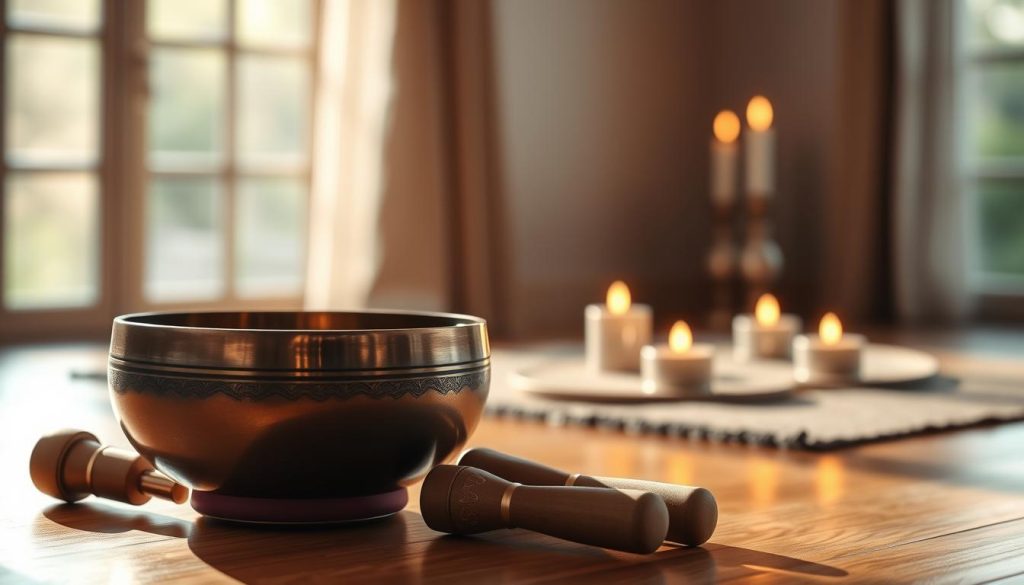
Discover a simple, progressive approach to getting started with sound practice. This article presents a clear roadmap for learning with confidence, without making medical promises, but with a genuine focus on relaxation.
Your first session is about choosing a suitable instrument and feeling its resonance. Patience and consistency are essential: a steady movement produces richer vibrations.
We explain how to make a bowl sing using accessible techniques. You will learn how to make your instrument sing while paying attention to your posture, intention, and the principles of vibration.
By practicing regularly, you develop technical control that transforms simple percussion into a deep sound meditation. This guide provides clear reference points so you can progress step by step.
Understanding the Tibetan singing bowl: a complete beginner’s guide
Traditional bowls produce a clear fundamental tone followed by overtones that enrich the sound. Each instrument has its own signature, shaped by its alloy and form.
Originating in the Himalayan region—Tibet, Nepal, India, and Bhutan—the Tibetan bowl was initially used in monastic rituals. Its use broadened over time.
Definition and operation
A bowl is a metal vessel that is struck or rubbed. Striking produces a fundamental tone, while rubbing amplifies the overtones. Learning to make the object sing requires patience and a steady movement.
Origins and cultural transmission
- Early ritual use in the Himalayas.
- Modern integration into yoga and meditation.
- The experience depends on the quality of the instrument and the practitioner’s intention.
| Region | Historical use | Modern use | Acoustic characteristic |
|---|---|---|---|
| Tibet | Monastic rituals | Meditation, sound baths | Rich fundamental tone |
| Nepal | Offerings and ceremonies | Yoga, relaxation | Pronounced overtones |
| India & Bhutan | Local traditions | Group sessions | Variety of alloys |
The physical principles of vibration and resonance
The physics of vibration explains why a metal instrument continues to resonate long after it is struck. A bowl’s fundamental frequency often ranges from 110 to 660 Hz, influencing its tone color and sustain.
Vibration begins in the metal and then travels through the air. Some of this energy is transmitted through conduction and can be felt in the hand or body when in direct contact with the bowl.
Resonance refers to the length of time the sounds remain audible after the initial attack. It is important when assessing the quality of a Tibetan bowl and its effect on the listener.
- The vibration of the metal produces the fundamental tone and its overtones.
- When touching the bowl, waves are transmitted directly and reinforce the relaxing sensation.
- Whenever the instrument vibrates, its sounds spread through the surrounding space.
| Characteristic | Value | Perception |
|---|---|---|
| Fundamental tone | 110 to 660 Hz | Perceived depth or pitch |
| Resonance (duration) | Short to long, depending on quality | Length of audibility |
| Transmission | Air and bodily conduction | Vibrations felt in the hand |
To learn more about the different models and their resonance, see these Tibetan singing bowl models.
Essential criteria for choosing your first instrument
Choosing an instrument begins with assessing its size and ability to vibrate for a long time. A diameter of 15 to 20 cm offers ideal versatility for beginners and makes the basic movements easier to learn.
Weight affects sustain: a heavier model often provides greater resonance. Aim for at least 30 seconds after a gentle strike; this is a simple criterion for judging quality.
The importance of size and weight
Diameter determines the note: a large instrument produces a lower sound, while a small model sounds higher. Greater mass supports the overtones and persistence of the tone.
Alloys and manufacturing methods
The traditional seven-metal alloy remains a benchmark in handcrafting. Hammered bowls develop rich overtones.
- Cast models are often more affordable and consistent.
- A wooden striker can make the bowl sing and produce more precise attacks.
| Criterion | Impact | Advice |
|---|---|---|
| Diameter | High or low note | Recommended diameter: 15 to 20 cm |
| Weight | Resonance | Heavier = sustain > 30 s |
| Manufacturing method | Overtones | Hammered = rich sound; cast = affordable price |
Essential accessories for comfortable practice
To get the most from your instrument, choose accessories suited to its size and vibrations.
A doughnut-shaped cushion leaves the bottom free to vibrate. It prolongs the sound and prevents energy loss against a hard surface.
Choosing a suitable mallet is crucial. A heavier mallet works well with large bowls and increases sustain. A felt mallet softens the attack and limits unwanted noise.
The striker, whether wooden or leather-covered, should match the diameter of the Tibetan bowl. A striker that is too small or too hard creates irregular vibrations.
- Suitable mallet: prevents unwanted noise.
- Doughnut-shaped cushion: prolongs the sound.
- Wooden or leather-covered striker: choose according to the bowl’s size.
- Avoid hard surfaces: they dampen the vibrations.
| Accessory | Use | Advice |
|---|---|---|
| Doughnut-shaped cushion | Allows the bottom to vibrate | Essential for better resonance |
| Heavy mallet | Large bowls | Improves sustain |
| Felt mallet | Soft attack | Reduces unwanted noise |
| Wooden or leather-covered striker | Rubbing and striking | Match it to the size of the Tibetan bowl |
In summary: every accessory, from the cushion to the mallet, should be chosen to ensure a comfortable and lasting sound experience. To learn more, see the available models and accessories.
Preparing your space and adopting the right posture
An uncluttered space and relaxed position allow the sound to unfold naturally. Settle in a quiet corner, away from drafts and surfaces that resonate too strongly.
Hand and body position
Adopting a good position is essential for making the bowl sing without creating tension in the body. Sit upright, either on a chair or cross-legged, and maintain the posture for at least ten minutes.
Rest the bowl on your open palm (the bowl resting on the palm), making sure your fingers do not touch its wall. Touching the wall dampens the vibrations and alters the tone.
- Hold the mallet like a pen, keeping your wrist flexible.
- Initiate the movement from your arm to maintain an even rotation around the rim.
- Take three slow breaths before beginning your meditation so you can center yourself.
| Element | Action | Why |
|---|---|---|
| Open palm | Rest the bowl without allowing your fingers to touch its wall | Preserves the vibrations and purity of the sound |
| Mallet | Held like a pen, with a flexible wrist | Allows a smooth, even movement |
| Posture | Stable, comfortable seated position for 10 minutes | Maintains concentration and relaxation |
Mastering the striking technique
A clean strike on the rim produces a precise attack and long sustain.
The striking technique consists of hitting the rim of the Tibetan bowl, never its base. Aim for the rim to obtain a clear note and well-defined overtones.
Choose the mallet according to the desired effect. A wooden mallet produces a dry, precise sound. A leather or felt mallet softens the attack.
Contact should be brief. Allow the mallet to rebound immediately after striking. This lets the resonance unfold without being dampened.
Learning to make the bowl sing by striking it is an essential step. Repeat the movement slowly until you become more consistent and confident.
- Strike the rim, not the base.
- Keep contact brief and let the mallet rebound.
- Wood = precise attack; leather or felt = soft tone.
- Practice regularly before moving on to rubbing.
| Element | Sound effect | Advice |
|---|---|---|
| Rim | Clear note and overtones | Aim for the rim at a slight angle |
| Wooden mallet | Clean attack | Ideal for getting your bearings and improving precision |
| Leather or felt mallet | Soft attack | Best suited to meditation and relaxation |
To explore the technique further, learn how to play a singing bowl and incorporate these movements into your routine.
Learning to make the bowl sing by rubbing it
Learning the rubbing technique requires a circular movement and careful attention to how the metal responds. The aim is to obtain a sustained note and smooth harmonic development.
Arm movement and consistency
Hold the striker at a 90-degree angle against the outer rim and initiate the movement with your entire arm. Keep your wrist flexible; the mallet should glide effortlessly.
Maintain constant pressure and uninterrupted contact so that the note stabilizes. An even movement encourages rich overtones to emerge.
Identifying the saturation point
The saturation point occurs when the mallet begins to bounce against the wall and produces a rattling sound. As soon as this happens, slightly reduce the pressure.
To see the vibrations, pour a little water into the bowl: the waves confirm the sustain and help you adjust the pressure.
- Position: striker at 90° against the rim.
- Movement: active arm, flexible wrist.
- Saturation: reduce pressure if rattling occurs.
- Contact: keep the mallet continuously against the wall.
| Element | Action | Result |
|---|---|---|
| Movement | Rotation initiated by the arm, with the striker held at 90° | Stable note and overtones |
| Pressure | Constant and adjustable if saturation occurs | Pure sound without rattling |
| Visualization | Adding water | Observation of the vibrations |
Learning to make your instrument sing takes patience and repetition. For more detail about the movements and technique, see this step-by-step guide.
Solving common difficulties during use
An uneven sound almost always indicates an incorrect movement or unsuitable accessory. Begin by checking that your fingers are not touching the wall, as this immediately dampens the vibrations.
If the tone is broken or uneven, slow the movement. Excessive speed or uneven pressure causes knocking sounds. Try to maintain constant pressure and observe the result.
Change the mallet if the sound is too high or percussive. A leather or felt head softens the tone. A heavier mallet, often made of wood, increases sustain.
Make sure the bowl rests steadily on your hand (the bowl resting on the palm) and that your position is comfortable. An unstable base creates unwanted noise.
- If the striker bounces, reduce the speed or contact angle.
- Change only one parameter at a time—angle, speed, or mallet—to isolate the cause.
- If the sound is too loud after striking, reduce the initial force.
In practice, patience and gradual adjustments will quickly improve how you use the bowl and your ability to make the instrument sing.
Building a daily practice routine
A few minutes each day are enough to establish a lasting sound practice. A session of 5 to 15 minutes helps form the habit without pressure.
Time management and frequency
Set aside a regular time each day, either morning or evening. Consistency supports progress more than session length.
The silences between sounds matter as much as the attacks. Allow several seconds after each note so your nervous system can absorb the experience.
Begin by gently striking or rubbing your bowl, then listen. Record a few sessions to monitor your progress and refine your movement so you can make the bowl sing more effectively over the weeks.
- Short routine (5 to 15 min): easier to maintain.
- Regular meditation: cumulative effects.
- Listening to silence: sensory integration.
- Finishing in stillness: grounding before resuming your activities.
Use practical advice and a step-by-step guide to follow a simple, steady progression.
Exploring the benefits of sound meditation
Low, sustained sounds provide a focal point that can steady your attention and reduce repetitive thoughts.
Sound meditation helps recenter the mind and create a clear transition between activity and rest.
- The practice steadies the mind by providing an auditory reference point—the bowl.
- Using bowls promotes deep relaxation associated with alpha and theta waves.
- Observing water inside a bowl encourages concentration and calms the mind.
“Several practitioners report reduced stress and a stronger sense of energetic harmony.”
| Goal | Situation | Result |
|---|---|---|
| Transition | Short break between two tasks | Immediate mental calm |
| Sleep | Slow session with lower notes | Makes it easier to fall asleep |
| Exploration | Observing patterns on the water’s surface | Deep sensory grounding |
For an effect conducive to sleep, favor lower notes and allow the resonance to fade naturally. Incorporating several bowls or a set of singing bowls enriches the experience and creates more complex soundscapes.
Tips for varying sounds and experiences
Alternating sound textures refreshes your listening and broadens your instrumental palette.
Space out your strikes when layering the sounds of several bowls to prevent saturation and allow each note to breathe.
Water inside a bowl changes the resonance duration and creates a soothing visual reference during the session.
- Vary the sounds by alternating a wooden mallet for a clear tone with a leather-covered striker for deeper sounds.
- Play several bowls of different sizes to obtain complementary frequencies and gentle harmony.
- Filling a bowl three-quarters full makes the vibrations visible and helps you adjust the pressure.
- Experiment with different rotation speeds to discover the full range of overtones.
- Learn to work with silence and intensity: this is often what makes an experience richer.
To go further, consult a resource devoted to practices and accessories.
Conclusion
In conclusion, remember that a stable sound depends as much on the instrument as it does on how you listen.
Choose a Tibetan bowl that resonates for at least 30 seconds. This ensures a rich sound experience and useful listening time for meditation.
Mastering the singing bowl depends on an even movement, constant pressure, and smooth contact between the mallet and rim. Match the mallet to the diameter and try a wooden or leather-covered striker according to the effect you want.
Regular practice and patience remain essential. To go further, read about Tibetan singing bowls in sound therapy and continue exploring with confidence.