
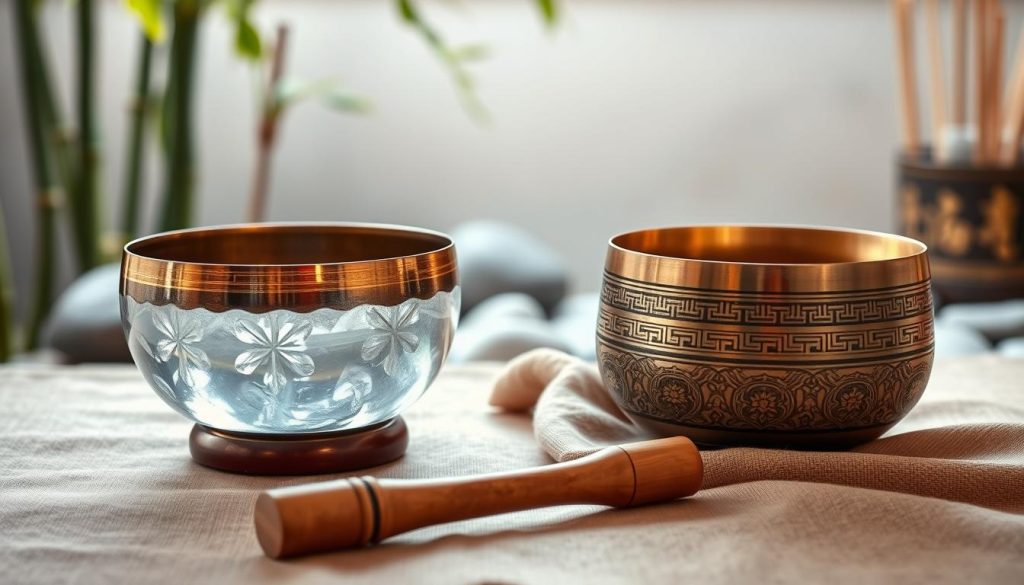
The Tibetan singing bowl has accompanied the quest for the sacred in Himalayan temples for centuries. It serves as a meditation and relaxation tool thanks to its vibrations and richly harmonic sounds.
Before you choose the ideal bowl, consider its composition and size. A quartz model produces clear tones, while a traditional alloy offers warmer harmonics.
Handcrafting influences the tone and reach of the vibrations. These instruments encourage grounding and a regular meditation practice.
Practical tip: try bowls of different sizes to feel their effects on your body. Their sounds promote awareness and relaxation; the right size will suit your space and intention.
Crystal or traditional Tibetan singing bowl: understanding the differences before choosing
Understanding how a bowl produces its note changes how you view its use.
A singing bowl emits a note when its surface is rubbed with a mallet. This phenomenon results from vibrations in the material and the instrument’s shape.
Historians and practitioners still debate exactly how these bowls were used in the past. Their present-day function is clear, however: marking the beginning and end of a meditation session.
Differences in materials directly affect tone color. Metal bowls offer warm harmonics. Crystal models, which emerged in the 20th century, produce purer tones.
Important: before you choose a bowl, learn about the model’s note and sound projection. Whenever you make an instrument sing, you release frequencies that may help realign your internal energies.
For a quick comparison of the options and their sound qualities, see our practical resource: guide to bowls and crystals.
The fundamental differences between metal and crystal
Understanding the role of the material from which your instrument is made profoundly changes the listening experience. Here, we compare two families: traditional alloy and modern quartz.
Seven-metal alloy
The traditional model combines seven metals: lead, tin, iron, copper, mercury, silver, and gold. Each metal is associated with a planet and a specific chakra.
Advantage: the harmonics are warm and rounded, ideal for immersive meditation.
Important note: five-metal variants often lose richness in the lower register. If you are looking for a certain depth of sound, choose the complete alloy.
Properties of quartz
A quartz bowl is made from heated silica that transforms into quartz. This material is believed to amplify recognized crystal-healing properties.
Its sounds are higher and more precise. They amplify the instrument’s vibrations and support targeted energy work.
- Low tones and warmth: metal (rounded sound).
- Precision and clarity: quartz (high notes).
How size influences sound vibration
An instrument’s size determines its range and sustain. A larger diameter lowers the pitch, while a smaller model produces a higher sound.
Available sizes: bowls range from 11 cm to 55 cm. Models measuring around 11 cm produce high, striking sounds. By contrast, a 55 cm bowl delivers very low notes.
How diameter affects sustain
Sustain increases with size. A large instrument, especially one made of quartz, holds its note longer. This encourages deep vibrations for relaxation and work focused on the lower body.
- 11 cm: easy-to-carry format with high, dynamic sounds.
- 19 cm: excellent tonal balance for everyday use.
- 55 cm: low notes and extended sustain.
Wall thickness also influences projection and harmonic richness. Crystal bowls are often thicker and heavier than metal models, making them less portable but extending the duration of the note.
To compare sizes and uses, see our practical guide: What size singing bowl should you choose?
Matching your bowl to chakra frequencies
An instrument’s resonance can target a specific chakra and enhance your meditation practice.
Each bowl is tuned to a note that resonates with one of the seven energy centers. For example, C and C-sharp correspond to the root chakra. The note B is associated with the crown chakra.
To work on the heart chakra, look for a bowl tuned to F or F-sharp. This frequency encourages emotional openness and compassion.
Quartz models offer note precision similar to that of a piano. Crystal bowls maintain a stable note, which is useful for extended relaxation.
| Chakra | Associated note | Recommended use |
|---|---|---|
| Root | C / C-sharp | Grounding, stability |
| Heart | F / F-sharp | Emotional openness, compassion |
| Crown | B | Spiritual connection |
Practical tip: match your instrument’s size and material to your goal. To learn how to choose a note, see our dedicated page.
The importance of resonant frequency
The right frequency can turn a simple vibration into a restorative experience.
The modern standard is 440 Hz, which is used to tune most instruments. However, 432 Hz is gaining supporters who believe it has a more soothing effect on living beings.
Sound therapists also work with 528 Hz, which is reputed to have restorative properties.
A bowl tuned to 432 Hz may make the practice feel gentler. According to some practitioners, an instrument tuned to 528 Hz is intended to support cellular regeneration.
Tuning stability: a crystal model often maintains a more stable note. High-quality quartz provides precise resonance, which is useful for chakra work.
Practical tip: test your bowls’ vibrations before buying. Avoid combining instruments tuned to different reference frequencies, as this may create audible interference.
| Frequency | Intended effect | Practical advantage |
|---|---|---|
| 440 Hz | Musical standard | Compatibility with other instruments |
| 432 Hz | Calming | Believed to resonate better with living beings |
| 528 Hz | Restoration | Used in sound therapy |
Essential accessories for your practice
Simple tools ensure purer vibrations and safer practice. They optimize sound quality and protect your investment.
The role of the mallet
The mallet influences the note and harmonics. A felt model emphasizes the fundamental note and produces prolonged, rounded resonance.
A hard striker brings out the harmonics and sharpens the attack. Choose according to the effect you want.
The purpose of a support cushion
An O-ring cushion stabilizes the instrument. It prevents slipping and eliminates unwanted resonance.
For a crystal bowl, this support preserves the purity of the note and reduces the risk of cracking.
- Suitable mallet: shapes the attack and sustain.
- Support cushion: ensures a clear, stable note.
- Protective case: recommended for transport and storage.
- Included accessories: high-quality sets often include a mallet and cushion.
To better prepare for the purchase of an instrument and its accessories, see our buying guide. It will help you harmonize your meditation practice and preserve your singing bowls.
Assessing price and manufacturing criteria
Understanding what influences an instrument’s price helps prevent impulse purchases.
The manufacturing method is a key factor. Hand-hammered models require considerable time and expertise. They offer greater harmonic richness, which explains their higher price.
Hand hammering or industrial molding
Mass-molded bowls are manufactured quickly. This production method ensures consistent note precision, especially in crystal and quartz models made in molds.
The thickness of the quartz affects the cost: a denser, heavier model costs more. Prices for small instruments start at around €60, while large 55 cm bowls can cost as much as €2,200.
- The price depends on weight, alloy, and manufacturing method.
- A hammered bowl offers richer harmonics in return for a larger investment.
- Crystal singing bowls are produced industrially to achieve a precise note.
- Setting your budget according to your intended use prevents repeat purchases; sometimes it is better to invest only once.
| Criterion | Effect on price | Sound consequence |
|---|---|---|
| Method (hammering/molding) | Higher price for a hammered bowl, lower for a molded bowl | Richer harmonics from a hammered bowl |
| Material (alloy/quartz) | Quartz is often more expensive depending on its thickness | More precise note with quartz |
| Size | Price increases with diameter | Longer sustain and stronger low tones |
Choosing your instrument according to your well-being goals
The nature of the vibrations determines an instrument’s ideal use. For meditation, choose a steady, stable sound that aids concentration.
For energy work, aim for the note associated with the target chakra: this amplifies the resonance and reach of the practice.
A medium-sized metal model remains the best compromise for a portable practice. It has a reasonable weight and offers sounds suited to different uses.
Quartz instruments stand out for their precise notes. They are well suited to treatments where tuning stability is essential.
- Deep relaxation: choose a large bowl that produces sustained low tones.
- Heart-chakra work: select an instrument tuned to the corresponding note.
- Portable practice: choose a medium-sized metal model.
Handcrafting: a hammered model offers unique harmonics and a distinctive sonic identity. Whatever your budget, always test the instrument to make sure its resonance meets your expectations.
To compare the different families and notes, see our guide to the available models.
Conclusion
Ultimately, the resonance that speaks to you remains the best criterion.
Your bowl’s fundamental note is its sonic identity. It helps harmonize the chakras during practice.
Take the time to listen to several notes before choosing an instrument. Crystal models offer excellent pitch precision.
Metal versions provide a vibrational warmth rooted in traditional practices. Every bowl retains its own unique tone.
Investing in quality ensures a lasting sound experience and genuine support for your everyday well-being.