
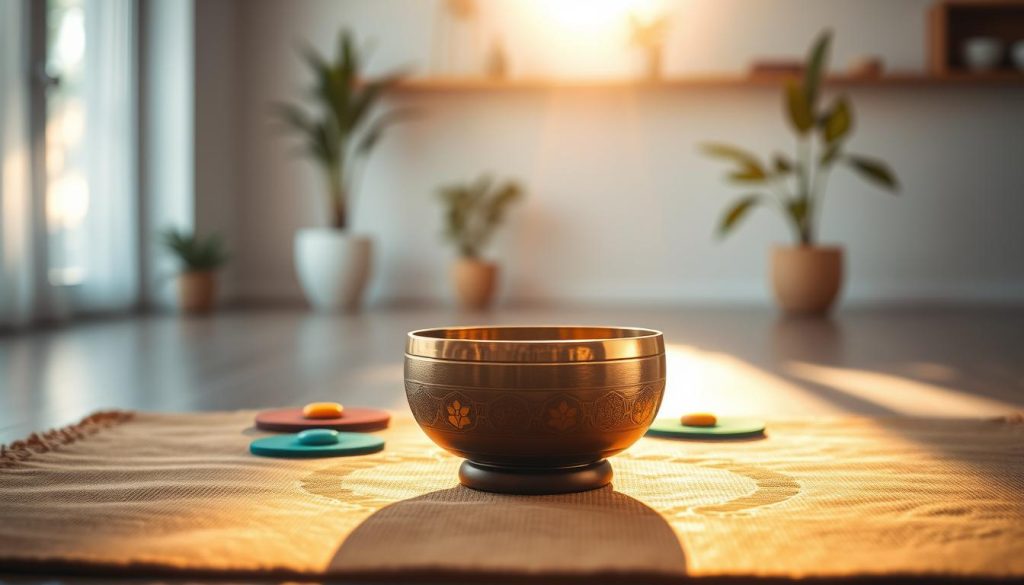
This guide introduces the basics of incorporating a Tibetan singing bowl into your routine. The Yoga Upanishads, written between 700 and 1300 CE, contain the earliest traces of the energy-center system. Here, we clearly explain how this instrument can support inner harmony.
In this article, you will find ancient and practical methods for using a Tibetan singing bowl and releasing blockages. Each bowl’s unique sound interacts with your body’s frequencies and helps ease tension.
Practicing several times a week encourages a deeper connection with your essence. Learning requires patience, but the emotional benefits can emerge quickly.
Follow this guide to understand the theory and simple techniques that can improve your well-being.
Understanding the chakras and their energetic role
Understanding where these points are located helps you direct your sound practices. The major energy centers act as energy relays along the spine, from the base to the crown of the head.
The seven centers — Muladhara, Svadhishthana, Manipura, Anahata, Vishuddha, Ajna and Sahasrara — govern the body’s vitality and the quality of our emotions.
Definition of the energy centers
These invisible points already appear in the Yoga Upanishads. They govern the circulation of energy and influence physical health.
Symptoms of blocked energy centers
- The root chakra (Muladhara), at the base of the spine, influences security and stability.
- A blockage in the solar plexus can cause emotional difficulties.
- The third eye governs intuition, while the throat relates to personal expression.
“When your singing bowls resonate, they target these areas to help restore their natural balance.”
| Center | Position | Main function | Common symptom |
|---|---|---|---|
| Muladhara | Base of the spine | Security | Insecurity |
| Manipura / solar plexus | Upper abdomen | Willpower | Emotional instability |
| Ajna (third eye) | Forehead | Intuition | Lack of clarity |
Understanding these functions allows you to use your bowls with a precise intention. To explore sound protocols in greater depth, see our practical guide: chakra resonance protocol.
Why does a Tibetan singing bowl influence your energy centers?
The sound of a singing bowl enters the silence and subtly alters the body’s internal rhythms.
For centuries, monks have used Tibetan singing bowls to encourage states of deep meditation. The instrument creates waves that interact directly with the chakras. These waves restore a smoother, more soothing flow of energy.
The bowls produce deep vibrations. They penetrate the body’s subtle layers and promote lasting relaxation. The vibration acts as a form of energy work.
- Resonance targets areas where energy has become stagnant.
- Each bowl acts like an energy “doctor,” helping to loosen blockages.
- After a session, people often experience greater mental clarity and inner spaciousness.
“Sound frequencies help the body regain its balance after a period of stress.”
| Action | Mechanism | Perceived effect |
|---|---|---|
| Resonance | Harmonizing frequencies | Immediate calm |
| Rubbing | Producing continuous vibrations | Deep relaxation |
| Targeted placement | Local interaction with a chakra | Release of blockages |
Tibetan singing bowls and chakras: how to use one properly for the best results
Selecting the right frequency transforms a simple session into a targeted sound massage. Before each session, choose the Tibetan singing bowl that matches your intention. This step lays the groundwork for effective meditation.
Sound massage often requires a professional to place the bowls directly on the body. The method involves targeting each major chakra and then allowing the vibration to work for several minutes.
Everyone responds differently to vibrations. Take time to observe their effects on your energy and bodily sensations. For example, a practitioner may place a bowl on the solar plexus to encourage deep relaxation and emotional release.
Repeat the process several times to anchor the harmonizing effect. When a sense of well-being emerges, it is often a sign that energy is flowing freely through your vital centers.
“Repetition and attentive listening are the keys to a lasting effect.”
To explore these protocols further, see our practical chakra guide.
Choosing the right singing bowl for your needs
A bowl’s size and material determine the depth and clarity of its resonance. Size influences depth: large instruments produce low notes that are ideal for the base or root. Smaller bowls produce higher tones suited to the head or third eye.
How size influences resonance
A large bowl vibrates more slowly and produces a deep note. This resonance encourages grounding.
A smaller bowl produces a clear note with faster vibrations. It promotes mental clarity.
The importance of musical notes
The note produced is often associated with a specific chakra. Test several notes to find the one that resonates with you.
“The right note makes it easier to harmonize the energy centers.”
Vibrational frequencies and well-being
Alloy bowls are hammered by hand and offer a rich harmonic range. Quartz crystal bowls produce a pure, stable note.
The 432 Hz frequency remains popular because of its perceived connection with nature, while the modern standard shifted to 440 Hz in 1975.
- Tip: to discover which instrument suits you, choose your singing bowl by testing several notes.
Essential accessories for revealing your instrument’s voice
Accessories transform a simple object into a genuine sound tool. A mallet should be at least as long as the Tibetan bowl’s diameter to ensure optimal projection.
Choosing the contact material: a wooden stick produces a crisp attack. A suede or felt-covered mallet creates a rounder, more enveloping tone.
The mallet’s size should be proportional to the diameter of the bowls. If it is too small, the resonance becomes muffled; if it is too heavy, it masks the harmonics.
- Each side of a mallet provides a different nuance for exploring the sound palette.
- Support cushions isolate the metal from hard surfaces and stabilize the instrument.
- Investing in quality accessories extends the life of a Tibetan singing bowl.
“A felt-covered mallet produces a rounded sound that is ideal for phases of deep relaxation.”
To learn more about sound-therapy instruments and their accessories, see our dedicated guide.
Mastering striking and rubbing techniques
Learning precise movements transforms simple contact into controlled resonance.
Controlled striking: gently strike near the rim to produce a clear, steady note. Touch the bowl with the mallet, then let the sound develop. Allow the vibration to fade before striking it again.
Circular singing: move continuously around the rim, holding the stick at an angle of approximately 20 to 30 degrees. Maintain even pressure to produce deep vibrations.
Avoid touching the rim directly with your fingers. This contact would dampen the instrument’s vibration during the massage.
- Each side of the bowl responds differently; change the angle to find the optimal area.
- The method requires practice so that the person receiving the massage feels the effect throughout the body, especially around the head and areas of tension.
- Pause between strikes to prevent sonic overload.
“A slow, steady movement creates a deeper sense of relaxation.”
Preparing your space and intention before the session
Creating a soothing atmosphere strengthens the connection between your intention and the resonance of the Tibetan singing bowl.
Before sounding the singing bowl, dim the lights and eliminate sources of noise. Arrange your supports securely to prevent the bowl from tipping over.
Clearly define your intention: grounding, letting go or mental clarity. This step directs the practice and reinforces the effect of the sounds.
Practice a brief ritual of slow breathing for 1 to 3 minutes to prepare the nervous system before sounding the instrument.
- Clear each side of the room so the vibrations can circulate.
- Place your bowls on clean, stable cushions.
- Create a setting that encourages meditation and concentration.
“A carefully chosen space helps you receive the resonance fully.”
The regularity of your sessions will depend on your ability to recreate this sacred setting. For a complete protocol, discover our sound-healing session.
Protocol for positioning bowls on energy points
The way the bowls are arranged directly influences the quality of the sound massage experienced by the recipient.
General principle: position the bowls along the body’s vertical axis to harmonize energy from the base to the head. The choice of notes guides their placement.
Protecting sensitive areas of the body
For the root chakra, place the bowl between the person’s thighs or in front of their feet without applying pressure.
For the solar plexus, a bowl tuned to E is generally preferred. Contact should remain light and the volume moderate.
For the third eye, a bowl may be placed on the forehead, but keep at least 10 cm between the head and the instrument to avoid excessive stimulation.
- Avoid applying strong pressure directly to the throat; use a gentle vibration instead.
- Use several instruments to create a sound bath around the body and amplify the effect.
- Adjust the time spent on each area according to the resonance observed in the recipient.
“Precise placement combined with suitable notes enhances the session’s effect without overstimulating sensitive areas.”
For a guided practical exercise, discover our relaxing session for the seven chakras.
A sound sequence for opening and closing the flow of energy
The sound structure begins with a clear ascent: F, C, G, D, A, E, B. This ascending sequence is used to open the flow from the root to the head.
Method: sound the bowls in pairs, allowing short pauses between them. The silence between strikes gives the vibrations time to settle into the recipient’s body.
Once the flow is open, the progression guides energy from the root chakra toward the crown. Observe the resonance in the body and adjust the strength of contact according to the response you perceive.
To close the flow, play the notes in reverse order. Gradually bring the energy back toward the base to encourage lasting grounding after meditation.
“Each instrument should be played with a precise intention; the quality of the silence shapes the final effect.”
For example, the pairing of F and B creates a sound channel that prepares the body to receive the other notes. Avoid abrupt contact with the instruments so the sound massage remains fluid.
Session rhythm and frequency for lasting balance
A regular session schedule stabilizes energy and encourages lasting change.
Consistency in practicing with your Tibetan singing bowl is the key to maintaining chakra balance. Practicing two or three times a week allows the body to integrate the vibrations gradually.
Each person should listen to their own rhythm. Adjust the length of the sound massage according to bodily sensations and responses.
The bowls’ vibrations often target the solar plexus and throat to release tension. Avoid prolonged contact if the person feels discomfort; move the bowl to another area for greater comfort.
- Tip: plan two or three sessions a week for a stable effect.
- Allow breaks between sessions so energy can stabilize from the base to the head.
- Over time, grounding at the root and clarity at the third eye become more pronounced.
“Regular, gentle and attentive practice transforms a one-time experience into lasting balance.”
Care and precautions for preserving your instrument
Simple, regular care preserves your instrument’s sound quality. Cleaning and storing it correctly prevents corrosion and changes to its notes.
Safe cleaning and storage
Always use a soft, dry cloth to wipe the surface. Avoid prolonged immersion in water to prevent the metals from rusting.
The seven traditional metals are gold, silver, iron, mercury, tin, copper and lead. A metal alloy requires special care: a fall can permanently alter the note.
- Store each bowl on a stable cushion, away from edges.
- Avoid harsh chemicals that damage the patina.
- Keep the bowls separate to prevent scratches.
Mistakes to avoid when handling the bowl
Striking too hard can cause invisible cracks. Repeated impacts reduce the purity of the sound.
“Regular care ensures that each instrument retains its unique sonic signature.”
| Mistake | Consequence | Solution |
|---|---|---|
| Prolonged immersion | Corrosion | Wipe with a dry cloth |
| Dropping the bowl | Altered note | Use a stable cushion |
| Harsh products | Loss of patina | Clean gently |
To deepen your knowledge of care and materials, see our guide to everything you need to know about singing bowls.
Conclusion
This guide shows that attentive listening and a clear intention transform each session into genuine inner work.
Regular practice with a Tibetan singing bowl can bring a noticeable improvement in relaxation and energy. A single, carefully chosen note can support grounding during meditation.
Learn how to choose a suitable singing bowl, care for your bowls and structure your sessions. Everyone experiences sound massage differently, so observe the effects and adapt the method.
We hope this article helps you use your bowl to enrich your daily life. Take care of your instrument: it can become an ally on your path toward balance.